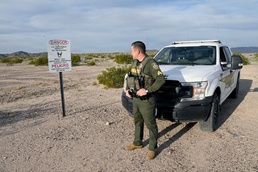
Trespassing on the vast desert ranges of U.S. Army Yuma Proving Ground (YPG)’s Yuma Test Center (YTC) is dangerous.
Unauthorized entry into any military installation is a crime, but the proving ground has a host of hazards that are as unique as its mission testing virtually every piece of equipment in the ground combat arsenal in a natural environment.
After more than 80 years of existence and plenty of posted no trespass signs, you might think people would steer clear of these areas.
But you would be wrong. And instances of trespassing have been stubbornly persistent in recent years, necessitating a vigorous enforcement response from the YPG Police Department.
Though there is always the possibility of encountering people with harmful criminal intent, officers say many of the trespassers are only inadvertently breaking the law. “There are a good handful of people that I run into out there that are genuinely good people,” said Sgt. Gregory Harper, YPG Conservation Law Enforcement Officer. “They are cooperative and their intent isn’t bad, but that won’t protect them from the hazards on our ranges.”
In addition to the possibility of unexploded ordnance from the proving ground’s distant history as a massive desert training facility formed by General George S. Patton during World War II, YTC’s 1,300 square mile ranges accommodate the surface danger zones for test fires of powerful long-range artillery shells and airdrops of cargo parachutes carrying multi-ton pallets of equipment or military vehicles. The testing of laser targeting technology in the area also carries the risk of causing serious eye injuries to unwitting persons traipsing in areas that they do not belong.
Beyond this, YPG’s rugged terrain and hostile temperatures are hazardous enough. Things like comprehensive cell phone signal availability that are taken for granted in populated areas are far from a given in the most remote, mountainous portions of YPG, which further complicates rescue efforts.
“A lot of the desert areas are not as flat as you would think they are,” said Harper. “There are quite a few hills and washes that dive straight down, and so many different fingers off of those washes that are a lot more comprehensive than people think. There are areas that I have difficulty getting to even in my OHV, and every storm changes something.”
In recent years, the State of Arizona authorized YPG concurrent criminal jurisdiction. Until the change, YPG Police only had the authority to issue DD Form 1408s, which have no penalty or deterrence associated with them for individuals who are unaffiliated with the Department of Defense. Now, YPG Police are empowered to issue Central Violations Bureau (CVB) citations, which are adjudicated by a U.S. District Court.
“Our policy is to educate and issue a warning the first time unless there is a more serious offense connected to the trespassing,” said Harper. “Even a verbal warning is annotated in our system.”
The dangers to life and limb are scary enough, but trespassing within YPG’s borders can also degrade the proving ground’s range conservation efforts and mission readiness. “We want to preserve wildlife habitat, but the larger objective is supporting our test mission,” said Daniel Steward, YPG wildlife biologist. “These ranges are our natural laboratory and we try to keep them as pristine as possible.”
Steward says that federal law allows for some public access to military installations, an obligation the proving ground takes seriously.
“We provide for some limited public access where it’s not interfering with our mission,” he said. “We permit hunting in very specific areas and with our range controllers notified of where it is taking place to keep people safe. If we have unauthorized access and range control is not aware of it, it puts people in danger and affects our test mission.”
YPG’s successful wildlife conservation efforts have enabled thriving populations of a variety of creatures that are imperiled in many other places in the American West, from bighorn sheep and Sonoran pronghorn to fringe-toed lizards and the Sonoran Desert tortoise. They have also provided ample habitat for numerous species of bats in several abandoned mines that predate the proving ground’s existence. The mines, however, also attract trespassers, which can wreak havoc on fragile roosting locations for the bats, natural predators of all manner of pesky insects.
“When there is a bat breeding colony in a mine, one entry is all it takes to wipe out an entire reproduction season for those bats,” said Steward. “A lot of bat species are very high conservation concern because of the lack of habitat availability.”
Additionally, Steward adds, isolated abandoned mines are extremely dangerous places for people to visit.
“Mines are flat-out hazardous,” Steward said. “They have bad air, unstable ground and ceilings, and deep, sometimes flooded shafts. They are real death traps. Stay out and stay alive.”
In his career at YPG Harper has responded to multiple calls to extract individuals from abandoned mines, including a harrowing incident in 2024 where personnel from multiple law enforcement and government agencies needed 12 hours overnight to extract a woman with a broken ankle stuck at the bottom of a 200-foot-deep mine shaft within two miles of YPG's ranges.
“Those mine shafts are so volatile: anything can collapse them,” said Harper. “We didn’t know the air quality where she was located. It was nerve-racking because we were trying to get things coordinated and start making decisions.”