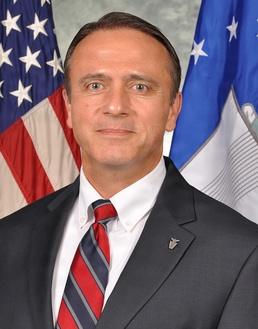
In a rapidly shifting global landscape, the Air Force Life Cycle Management Center’s Mobility Directorate is at the forefront of preparing for future conflicts. We sat down with Kevin Stamey, the Program Executive Officer (PEO) for Mobility and Director of the Air Force Life Cycle Management Center’s Mobility Directorate, to discuss the directorate's urgency, and how his team works to ensure the readiness and survivability of the Air Force’s airlift and tanker fleet. As PEO, Stamey is responsible for the acquisition, modernization, and sustainment of C-5, C-17, C-130, KC-46, and KC-135 aircraft.
Q: The Mobility Directorate released its 2026 Strategic Plan last fall. How does it align with the acquisition guidance we’ve received from the Secretary of War? Stamey: The plan aligns very well with the SECWAR’s guidance. Two years ago, we started what we branded as 'Accelerate for 2028', which was all about preparing for a conflict in a three-to-five-year time frame against a peer adversary. The major change in the 2026 strategic plan is that the time horizon is now two to three years. It's 100 percent consistent with what SECWAR asked us to do: act like we're on a wartime footing. We have to do things differently, and in some cases, ‘break glass.’
Q: Looking beyond the immediate future, what significant long-term trends are shaping the future of mobility? Stamey: One of the main drivers is what we call the long-range kill chain. Our adversaries are building long-range threats specifically to push assets like our tankers further back. They believe it’s easier to target and shoot a tanker than an F-35 or F-47. The most important thing we can do to increase the survivability of the mobility fleet is to make them more connected.
Q: You place a major emphasis on "connectivity." What does that mean in practice for a tanker or a C-17 crew? Stamey: Think of Starlink, or the Department of War version, Starshield. We're putting that high-bandwidth connectivity onto our aircraft to give them real-time situational awareness. Today, tankers and C-17s don't have the same battlespace awareness as a fighter. In a hypothetical situation, they could be on a mission headed to a runway that no longer exists, and they won't know that until they were on final approach - without enough gas to go someplace else. If they were better connected into the battlespace network, they would have accurate information long before they headed to that runway. Connectivity and survivability are the primary driver of the Lines of Effort in our strategic plan.
Q: Are you taking lessons from the conflict in Ukraine regarding aircraft survivability and communications? Stamey: Absolutely. I think what we've learned is that communications will be jammed, so you need resilient communications. This is driving the push for what we call pLEO or Proliferated Low Earth Orbit satellite constellations. We're looking at hybrid solutions that use different sets of satellites. If an adversary were to find a way to take one down, we'd have another constellation to rely on.
Q: With a two-to-three-year timeline, how do you balance investing in readiness for the current fleet versus buying new systems? Stamey: We prioritize readiness. Aircraft availability is our Line of Effort number one. The reason for that is if we're going to have a conflict in this timeframe, we're going to war with the fleet we have. Some of these newer weapon systems are outside that window. So, the best thing we can do to deter or win a conflict is to get the existing fleet we have as ready as possible. This means we have to get creative, using things like additive manufacturing and partnering with smaller, non-traditional vendors to do things more agile.
Q: So how are you working with industry partners to drive the innovation you need? Stamey: We're looking at different sources than we would typically go to. Where there is a commercial solution that's an 80 percent answer, we want to take what industry is already doing. Connectivity is a good example. The Department of War isn't going to replicate to the scale and scope that SpaceX is doing with Starlink. So, we partner with them.
Q: What cutting-edge technologies is your team exploring? Stamey: Some technology that we are really looking at is kinetic self-protection for our high-value airborne assets. Because the threat is evolving, we are trying to develop a capability to protect the tanker that is independent of that threat. Whether it's an IR seeker or a radar seeker, if we have a means of taking it out kinetically, we don't have to electronically attack it or use decoys that are effective against some things, but not others. We consider kinetic self-defense to be sort of a last line of protection. If all else fails and a threat somehow breaks the kill chain, we’ll still have a means to protect the tanker. The technology is necessary if we're going to be successful in pushing tankers into what we call the weapons engagement zone.
Q: What excites you most about leading the mobility portfolio right now? Stamey: What excites me is that the mobility fleet underpins everything we do as a joint force. Without mobility, the fighters don't get there, the bombers don't get there, and there's no ammunition, troops, or tanks. I'm passionate about connectivity and survivability. It just doesn't sit well with me that we have operators [aircrew] who knowingly put themselves in harm's way. I, as an acquirer, owe them something better, and so I'm going to do everything I can to give them the ability to survive.