Enduring infrastructure is not built in a day – nor is it built by one person. It is built by a team that shares purpose, expertise, and trust, all working together towards a higher ambition.
For one of the U.S. Army Corps of Engineers (USACE) Pittsburgh District’s flagship projects, that ambition includes building a new lock chamber at Montgomery Locks and Dam, one of the oldest and smallest navigation facilities on the Ohio River. The project’s stakes are high – millions of tons of cargo pass through the lock each year, and an extended closure could cost the national economy more than $180 million.
That long-term effort and shared commitment earned national recognition. The U.S. Army Corps of Engineers awarded the Montgomery Lock New River Chamber Project Delivery Team (PDT) the 2025 USACE Project Delivery Team of the Year award, recognizing the group’s performance on one of the nation’s most complex inland navigation projects.
“It is the district’s responsibility to advance a project the region and the nation can rely on for generations,” said Col. Nicholas Melin, the commander for the Pittsburgh District. “This award reflects the PDT’s commitment to planning, coordinating, and delivering on that responsibility. It’s a proud moment for the Pittsburgh District and for everyone across the enterprise who helped move this project forward.”
After Congress authorized the new lock chamber in 2016, the PDT engaged in a multiyear effort not only to plan a solution but also get the engineering right for infrastructure that has a 50-year design life. However, the new chamber should serve the region and the nation for more than a century.
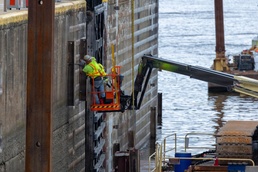
When crucial funding arrived in 2022, the PDT had the groundwork already in place, allowing the team to move quickly from planning to execution. The PDT has worked at a breakneck pace to award contracts, stand up an onsite concrete batch plant, and begin removing the old auxiliary lock chamber.
The Montgomery PDT is made up of people from across the USACE enterprise – engineers, planners, cost estimators, real estate specialists, contracting professionals, and operations staff – to deliver the project. To deliver the designs and complete necessary pre-construction activities, more than 700 USACE employees from 26 districts and centers of expertise supported the project.
Many had never worked together before, and aligning schedules, standards, and expectations across dozens of offices required constant coordination and trust.
Strong planning helped make that possible. Early in the process, the PDT developed a detailed project management plan that identified risks, mapped schedules, and defined responsibilities before construction funding was in place.
“I’m grateful to have had the opportunity to work with such a great group of people,” said Chris Dening, the Pittsburgh District’s mega projects team chief. “There is still a lot of work to be done, but our team is ready and continues looking forward to delivering this project.”
The early planning effort enabled the team to keep critical commitments to navigation partners. When the district pledged to award the main construction contract in fiscal year 2024, the Montgomery PDT delivered.
In the past year, that planning turned into corporal progress. Crews prepared work areas, improved access roads, and built an on-site concrete batch plant to supply concrete for the new chamber. These early steps help reduce possible delays and keep work on schedule.
At the same time, teams began preparing to remove the old auxiliary lock chamber. Removing parts of an aging structure requires care, coordination, and continuous monitoring to protect nearby facilities and the river.
“We’ve put a strong focus on carrying the team mentality forward as we begin the construction phase,” said Jenna Cunningham, the project’s resident engineer. “When the contractor and the onsite construction, engineering, and operations teams are working closely together, it makes a real difference in how smoothly and safely the project runs.”
Success on the project also depended on work beyond engineering and construction. Real estate, environmental, and cultural resource specialists worked early to secure land and approvals needed to support construction. Their work helped avoid delays and saved the project valuable time.
The team also found ways to reuse excavated and demolished material instead of sending it to landfills. By identifying safe reuse options, the project saved an estimated $100 million while reducing environmental impacts.
Construction is expected to continue into the early 2030s, with work structured to keep river traffic moving. When complete, the new chamber will remove a long-standing risk on the Ohio River system, supporting navigation reliability for decades to come.
“There is still a lot of work ahead, and we are committed to delivering it the right way – with reliable navigation on the upper Ohio River system and returning value to the nation,” said Col. Melin. “As construction continues, we will keep our emphasis on safety and coordination. The same team mentality that earned this award is what will carry the project through to completion.”