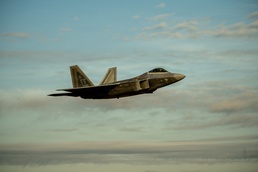
Air National Guard Warfighters Sharpen Combat Readiness During Sentry South 26.1
By Staff Sgt. John Macera, Kansas Air National Guard
SAVANNAH, Ga. — Air National Guard and joint forces from across the country converged over the Georgia coast Jan. 19-30, 2026, for Sentry South 26.1, a large-scale counterair coast exercise designed to prepare fighter units for modern, high-end combat operations at the Savannah Combat Readiness Training Center (CRTC).
The exercise brought together multiple aircraft platforms, air battle managers and maintenance teams to train in a realistic, contested environment that mirrors the complexity of real-world conflict, allowing units to sharpen tactical skills, improve joint integration and strengthen overall combat readiness before potential deployments.
Spanning hundreds of miles of restricted airspace and integrating live aircraft, ground-based controllers and simulated enemy threats, the exercise provided aircrews the opportunity to train in an environment that closely reflects operational conditions they would face in combat.
“This airspace is just a national treasure,” said Lt. Col. Joseph Walz, exercise director for Sentry South 26.1. “It is something that these guys can get here, that they cannot get at home. [Pilots] can fly to the full aperture of the jet without any of the training limitations that they might otherwise see. And that’s what makes it valuable.”
A Guard-Led Path to Readiness
Sentry South, formerly known as two separate exercises, Sentry Savannah and Southern Strike, is part of the National Guard Bureau’s broader readiness training program, pairing Savannah with Gulfport, Mississippi, as a southern counterpart to Sentry North, which will operate out of Volk Field, Wisconsin.
Together, the exercises provide total force Airmen and units realistic opportunities to prepare for potential deployment taskings with a larger footprint spanning across the northern and southern regions.
“What we’re trying to do is have two main exercises that people can go to certify their flying requirements and be ready to deploy,” Walz said.
While most participating squadrons were Air National Guard units, the exercise also integrated active-duty U.S. Marine Corps and total force Air Force units to reflect the joint nature of modern warfare.
Defensive and Offensive Counterair Operations
Training during Sentry South focused on two primary mission sets: Defensive Counter Air, DCA; and Offensive Counter Air, OCA.
In DCA scenarios, pilots protected designated target areas from incoming enemy aircraft, replicating missions such as homeland defense or the protection of allied forces overseas.
“If we were protecting something, you’d have multiple lanes of fighters defending key areas,” Walz said. “That’s what we’re training for here, just on a smaller scale.”
OCA missions required pilots to penetrate simulated enemy airspace, defeat surface to air threats and strike defended targets. Ground based electronic emitters replicated enemy missile systems, forcing pilots to detect, avoid or neutralize threats before completing their mission objectives.
A participating F-22 pilot said the complexity of scenarios mirrors real-world conflict planning.
“The way we execute our mission planning is very realistic to how we would do it in a major conflict,” the pilot said.
Controlling the Fight
Airmen assigned to the 134th Air Control Squadron, Kansas Air National Guard, monitored the battlespace using advanced command and control systems, tracking aircraft positions, maintaining airspace safety and directing tactical engagements.
“We help organize the forces, make sure the [mission] is going according to plan, and when it doesn’t, we make the most out of what we can in real time,” said Maj. Morgan Huttes, director of operations for the 134th ACS and Command and Control team lead.
Controllers managed altitude blocks and aircraft separation while delivering rapid tactical updates to pilots over limited radio frequencies.
“Every piece of information is time critical,” Huttes said. “You want to say things with as few words as possible while making sure that information is communicated and acknowledged.”
Data sharing between controllers and pilots was essential, particularly when digital systems were limited.
“Sometimes the digital information doesn’t get across, so you’re now having to build that picture through just words,” Huttes said. “So I'm making sure that the words that I am saying matches what the pilot is seeing in his cockpit.”
Huttes said working with multiple aircraft types strengthens mission effectiveness.
“All aircraft have different strengths and weaknesses,” he said. “It’s about learning how to maximize those strengths while minimizing collective weaknesses so we can meet the commander’s intent.”
Where the Real Learning Happens
Although sorties may have lasted less than an hour, the debrief following each mission often took longer than the flight itself.
Every missile shot, maneuver and tactical decision was reviewed by mission commanders and air crews using recorded flight data. Discussions focused on what worked, what failed and what must change before the next sortie.
“The real learning happens in the debrief,” Walz said. “That’s where the juice of the exercise is.”
The F-22 pilot said learning how other platforms operate was one of the biggest benefits.
“You learn what other aircraft bring to the fight and how they think,” the pilot said. “That helps us integrate better in real-world scenarios.”
Participation also builds confidence before deployment.
“These are how we’re going to go to war,” the pilot said. “It’s about getting extra reps before you’re under the pressure of live combat.”
A Team Effort on the Ground
While pilots executed complex missions in the air, maintainers and support personnel on the ground worked around the clock to keep aircraft mission-ready throughout the exercise.
“It takes a lot of teamwork and heavy maintenance, being ready to go at a moment’s notice,” said Senior Airman Desmond Gilbert, an F-22 aircraft maintainer supporting Sentry South 26.1.
During large scale exercises, maintenance operations move at a much faster pace.
“The maintenance pace when we’re doing live mission readiness is extremely high paced and high stress,” Gilbert said. “It’s at least six to seven times faster than normal operations.”
Maintainers played a direct role in pilot performance by ensuring aircraft systems were functioning properly and aircrews could trust their equipment before each sortie.
“You have to have a good rhythm between the crew chief, the maintainer and the pilot for the pilot to perform well,” Gilbert said. “If we perform poor maintenance, it throws them off.”
Despite the demanding tempo, Gilbert said the training prepared maintainers for deployment conditions.
“The pace of a deployment is being ready to go at a moment’s notice, and this exercise is just that,” he said. “Training like this prepares you to get up and go whenever needed.”
Walz emphasized that readiness depends on the entire team.
“This is a team sport,” he said. “You don’t get effective training without maintainers, controllers, planners and support Airmen all working together.”
Preparing for What Comes Next
As global threats continue to evolve, exercises like Sentry South play a critical role in ensuring Air National Guard units remain capable of integrating seamlessly with joint and coalition partners.
Sentry South 26.1 exposed aircrews to complex, contested environments and forced them to adapt under pressure,resulting in confidence and combat capability long before deployment orders arrive.
“This is about giving our people the tools they need before they ever see real combat,” Walz said. “So when that moment comes, they’re ready.”