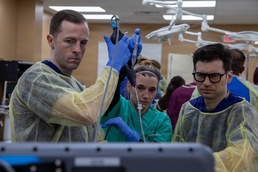
BULVERDE, Texas — U.S. Army Reserve 807th Theater Medical Command medical professionals built clinical confidence and sharpened life-saving skills during the Critical Care Skills Procedure Anatomy Program, a cadaver-based training conducted Jan. 30–31, 2026 at the Centre for Health Sciences, designed to strengthen medical readiness for future operations.
The intensive, hands-on course supports the Army’s preparation for large-scale combat operations (LSCO), where medical units must be ready to treat high volumes of complex casualties under austere and unpredictable conditions. By reinforcing foundational trauma skills and exposing providers to invasive procedures they may not routinely perform in their civilian careers, the training helps ensure the Army medical force remains adaptable, resilient, and capable of sustaining the fight.
For Maj. Gen. Michael Yost, commanding general of the 807th Theater Medical Command, the purpose of the training is directly tied to the realities of modern warfare.
“At the strategic level, military medicine exists to take care of Soldiers medically, but with the idea of returning them to duty as soon as possible, if at all possible,” Yost said. “In large-scale combat operations, we’re going to see a high volume of casualties. Training like this is about how you quickly and efficiently care for those patients, put them in a position to heal and rehabilitate, and ultimately get them back into the fight.”
The course provides a rare opportunity for medical professionals to practice high-risk, low-frequency procedures outside the urgency of real-world emergencies. Some participants work in civilian specialties that do not routinely involve trauma or emergency care.
“We have providers here who don’t do any of this stuff in their regular practice in the civilian world,” Yost explained. “This is a way to give them that exposure. In a large-scale combat operation, it’s going to overwhelm those who do this on a regular basis, so we’re going to need those who haven’t had those experiences to step up, know what’s going on, and know how to do things.”
That readiness, Yost emphasized, extends beyond clinical capability and directly impacts the morale and effectiveness of the warfighter.
“We provide that confidence to the warfighter that we will take care of them,” Yost said.
For attendees, the training reinforced the importance of continual learning and hands-on repetition. Maj. Cassandra Rusche, a physician assistant who works in pediatrics in her civilian career, described the experience as both necessary and rare.
“One of the most important things in both the military and medicine is that you continue to learn,” Rusche said. “These skills are perishable, and if we’re trying to save lives, and then teach other medics how to do the same thing, we have to get hands-on, and we just don’t get that opportunity very often.”
Beyond individual proficiency, the course is designed to create force multipliers across the Army medical enterprise. Participants are expected to bring knowledge back to their home units and train others.
“There aren’t enough of these courses, so we have to be able to take these skills, keep using them, and then teach other people how to use them,” Rusche said. “It builds confidence and trust in oneself… it is like see one, do one, teach one.”
The lab also challenges providers to operate outside ideal conditions, reflecting the realities of deployed environments.
“You always learn the textbook way, and that’s not what you’re going to be faced with,” Rusche said. “You might not have the supplies. Anatomy might look different. Being able to think on your feet, go back to the basics, and still be creative,” is what the course reinforces.
Capt. Nana Amma Asante, a nurse practitioner, echoed that sentiment, noting the value of exposure to critical procedures she does not routinely encounter in her civilian role.
“Based on the type of work I do on the civilian side, I don’t normally get exposed to the critical, hands-on part of our job,” Asante said. “Now, if a Soldier needs help in an emergency setting, I know I can step in and assist.”
Asante said the collaborative environment made the experience especially meaningful.
“Everyone here is helpful, working together and refreshing skills we may not have used since medical school or residency,” she said. “It’s been a very positive experience, and I’m proud of what I’ve been able to do here.”
The training was conducted in partnership with civilian instructor and department chair, Scotty Bolleter, a clinician, medical device inventor, and educator whose work focuses on bridging gaps between point-of-injury care and surgical intervention.
Bolleter said his civilian experience across multiple disciplines allows him to bring a broad perspective to military medical training.
“There is no higher calling than preparing someone to care for the sickest patients,” Bolleter said. “When it comes to the military, it’s about the men and women who put it on the line. There's no greater honor than to be able to do that kind of work.”
Yost said partnerships with civilian institutions like the Centre for Health Sciences are critical to sustaining and expanding this type of training.
“Anytime we can work closely with the civilian side to build our skills, it strengthens relationships and builds confidence, both within the military and in the communities we serve,” Yost said. “We can’t have enough collaboration.”
Looking ahead, Yost said expanding access to this training remains a priority, despite resource constraints.
“My wish is to develop more opportunities like this,” Yost said. “Even if providers can’t train on cadavers at their home units, they can take what they’ve learned and teach others using simulation. That’s how we spread this knowledge across the force.”
As Army medicine continues to modernize for future conflict, Yost encouraged medical professionals to seek out broadening opportunities that enhance both individual capability and collective readiness.
“Do things that are a little unusual, things that enhance your skill set, and then bring it back to the force and teach it where it’s relevant. That is imperative.”