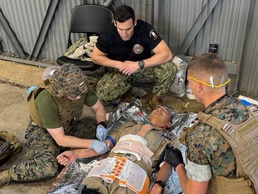
Strengthening Navy Medicine’s operational readiness and advancing standardized, joint trauma capability for future combat, Navy Medicine Readiness and Training Command (NMRTC) Fort Belvoir hosted the Joint Trauma System (JTS) Valkyrie Course to operate Emergency Fresh Whole Blood Transfusion (EFWBT) programs, Jan. 19–23.
For the Navy Medicine Enterprise (NME) and joint forces, blood is both a clinical necessity and a strategic resource. Maintaining adequate blood supplies requires refrigeration, transport, protection, and continuous resupply, all of which become increasingly difficult and costly in contested and distributed environments.
“JTS-Valkyrie standardizes Emergency Fresh Whole Blood Transfusion programs across the joint force,” explained Lt. Cmdr. Josh Kotler, JTS-Valkyrie program director at NMRTC Fort Belvoir. “This prehospital course provides the capability to project fresh whole blood resuscitation very far forward where cold-chain stored blood may not be available. The JTS is currently developing additional course tiers to standardize walking blood bank protocols and bulk whole blood collection for battlefield first aid and enhanced expeditionary medical platforms across the joint force.”
NMRTC Fort Belvoir is the first command within the NME to achieve accreditation from the Defense Health Agency JTS to conduct the Valkyrie Course. This training marked the command’s second iteration since provision certification and represents a scalable model for implementation.
“Becoming a certified Valkyrie site is about more than hosting a course,” said Capt. Andrew Lin, commanding officer of NMRTC Fort Belvoir. “It demonstrates Navy Medicine’s ability to generate and sustain standardized, interoperable trauma capability that directly supports the Fleet, joint, and partner-nation operations.”
In collaboration with U.S. Army’s Program Executive Office - Soldier Integration Facility, the course emphasized trauma decision-making, team coordination, and system-based care under operational constraints. Participants integrated clinical judgment with operational awareness, ensuring they can operate as part of an integrated joint medical network rather than as isolated medical assets. This joint approach reinforces interoperability across services and strengthens the medical force’s ability to support contested operations.
On the final day of the course, Kotler delivered a briefing and hands-on demonstration of the Defense Advanced Research Projects Agency’s (DARPA) Fieldable Solutions for Hemorrhage with bio Artificial Resuscitation Products (FSHARP) whole blood analog which was injected into a practical exercise scenario calling for more blood than a Valkyrie protocol could otherwise provide. Observers included representatives from the Office of the Chief of Naval Operations, the Defense Innovation Unit, DHA, and U.S. Navy Bureau of Medicine and Surgery.
“Blood is a strategic resource that drives real operational decisions,” concluded Kotler. “Artificial, shelf-stable blood allows commanders to preposition resuscitation capability forward without needing to activate or transport large quantities of blood in the lead up to or during combat. This preserves flexibility and protects a critical strategic resource.”
By integrating joint trauma training with emerging medical technology at NMRTC Fort Belvoir, Navy Medicine continues to move toward an operationally focused, standardized, and scalable approach to combat casualty care. The JTS-Valkyrie Course and exposure to programs like FSHARP demonstrate how the medical force continues to evolve as a critical enabler of naval and joint force operations in future conflicts.
The JTS-Valkyrie Course prepares multidisciplinary medical teams to operate EFWBT programs effectively during large scale combat operations and in distributed maritime environments, where evacuation timelines are extended and traditional medical infrastructure may be limited or unavailable. This training directly supports Navy Medicine’s operational transformation by aligning clinical skill sustainment with expeditionary medical requirements and joint standards.
The Navy Medicine Enterprise's 44,000+ talented and ready forces optimize health readiness, deliver quality healthcare, and provide global expeditionary medical support to warfighters.
For more information on DARPA’s FSHARP: https://www.darpa.mil/research/programs/fieldable-solutions-for-hemorrhage-with-bio-artificial-resuscitation-products