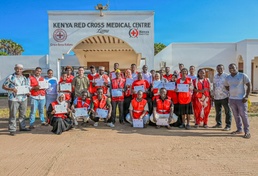
HINDI, Kenya — Soldiers assigned to Civil Affairs Team Kenya, Alpha Company, Civil Affairs Battalion, U.S. Army Southern European Task Force, Africa (SETAF-AF) engaged with multiple Kenyan civilian and military organizations to increase interoperability by conducting a medical camp, Dec. 11, 2025.
U.S. Army Capt. Andrew Hunt, team chief for CA Team Kenya, explained that a medical camp is an organized event that provides essential medical services to communities that would otherwise not receive treatment. Medical camps are significant for civil affairs efforts because they address the lack of access to medical treatment in underdeveloped regions — a core vulnerability CA teams have identified that can make local populations susceptible to recruitment by violent extremist organizations.
The CA team’s partners included the Kenyan navy’s Civil-Military Cooperation personnel, Kenyan naval medical professionals, the Kenyan Red Cross, Safari Doctors and the Lamu County Department of Health Services. The team worked as a liaison with these agencies to organize the event, while U.S. Soldiers assigned to Task Force Bataan and Kenyan army rangers provided security.
This event focused on increasing opportunities for medical treatment for civilians in Forward Operating Site Manda Bay Kenya’s area of operations, improving local perceptions of U.S. and Kenyan naval forces, and planning future joint activities. Medical and dental professionals treated approximately 250 patients during this one-day medical camp.
Hunt emphasized that the civil affairs mission seeks to minimize — or ideally, eliminate —negative impacts of military operations on civilians and help whenever possible. The information gathered during engagements like medical camps helps achieve these goals. These efforts not only provide humanitarian aid to underdeveloped regions, the goodwill generated from these events also improves the Army’s overall readiness if combat forces need to mobilize.
“Civil affairs teams provide critical information to the combatant commander to develop a detailed picture of the civil considerations in the area when planning kinetic operations,” Hunt said.
Doctrinally, the civil affairs mission set is intentionally about disarming, Hunt noted.
“If I took the perspective of a host-nation civilian who doesn’t have frequent interactions with U.S. forces, I would be suspicious of their intentions,” Hunt said. “The nature of our mission allows us to be upfront about our intentions and simply state that we’re here to listen to concerns of the community, identify existing vulnerabilities that can be exploited by bad actors, find solutions that address vulnerabilities, and reinforce that the U.S. military wants the same things the host nation wants: peace and security.”
According to Hunt, this event gave the CA team in Kenya a deeper understanding of the capabilities each partner provided. Such initiatives exemplify civil affairs’ role in sustaining Camp Simba’s mission and fostering positive relations with the local population.
“This collaboration helped identify potential civil vulnerabilities within the area and helped further develop a robust civil network,” Hunt said. “This will ultimately lead to improved coordination and enhanced security measures for U.S. military personnel assigned to Camp Simba. Engagements like these cultivate community support for U.S. efforts and mitigate threats posed by violent extremist organizations.”
CA Team Kenya’s future efforts will include maintaining the strong relationships it has established with the organizations that made the medical camp a successful event.
“Representatives from the groups we worked with said they would like to plan another medical camp,” Hunt said. “Going forward, we’re confident that the continued collaboration and dedication from these entities and others will help provide essential medical services until more permanent and accessible facilities become available.”