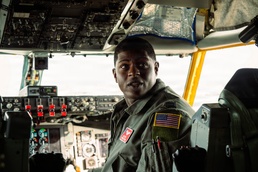
KEY FIELD AIR NATIONAL GUARD BASE, Miss. -- Some people might believe a pilot’s role begins and ends with flying the aircraft, but in reality it involves constant decision-making, leadership, and risk management. To those, a pilot’s office might always be in a cockpit 40,000 feet in the air instead of a workstation or cubicle. Yet military aviators are expected to handle both office duties and aircraft operation with ease. The capacity for dual responsibility and adaptability is critical for United States Air Force (USAF) pilots. According to Air Force Times, pilots make up approximately 10% of USAF personnel, and they operate the most advanced aircraft in the world to meet military objectives (Air Force Times, 2021). As commissioned officers, USAF pilots’ duties extend beyond the cockpit. They are also expected to manage a variety of ground-based planning and administrative functions. Capt. Alex West, a KC-135 Stratotanker pilot and current Chief of Scheduling in the 186th Air Refueling Wing Operations Group, has experienced firsthand the dual role of pilots as both aviators and military officers. From his commissioning as a U.S. Army Field Artillery officer to his transition to the 186th Operations Group in the Mississippi Air National Guard, West’s broad experience in the military has reinforced his ability to balance flight operations, administrative duties and leadership tasks. In a recent deployment to the United States Indo-Pacific Command (USINDOPACOM), West began the mission as an aircrew member before being tasked as the assistant director of operations (ADO). As the ADO, West transitioned from flying an aircraft to facilitating tasks for both the 613th Air Operations Center and the 618th Air Operations Center Tanker Airlift Control Center. “Although we are pilots, there is always the possibility that we may have to perform an additional duty. Being the ADO meant that I was going from solely being an aircrew member to a staff position in a leadership role as an officer,” West said. “My responsibility became facilitating tasks and determining priority levels with mobility aircraft versus operating an aircraft.” A typical day during his deployment began with alerts about a new mission. Once tasked, the crew was notified and transportation arranged. Briefings were often delivered en route to the aircraft. For West and his team, the unknown of each new day provided a thrill; they rarely knew the specifics or the duration of a mission beforehand. Achieving mission success required them to rely on their training and apply it to real-world challenges. Training for USAF pilots begins with developing core flying skills but eventually shifts to training to specific aircraft and missions in the operational force. Pilots also undergo rigorous combat and leadership training to ensure they become effective officers who can direct resources in addition to operating aircraft. “Something that I think is cool about being a pilot, is you are heavily trained to be a skilled aviator, but also a very capable leader,” West said. “Sometimes, we may be performing duty roles in addition to flying. However, we may be still called upon at short notice to fly a mission, which means maintaining skill proficiency as both pilot and leader is critical. The best pilots have learned to balance flying responsibilities, additional duties and leaderships tasks.” Deployed environments often provide members with opportunities to continue training away from home and learn new skills beyond their primary specialty. These experiences ensure USAF personnel are properly trained, equipped, and ready to deploy and execute any mission. Operating in those environments comes with its own set of unique challenges. As a pilot, officer and leader West acknowledges that regardless of an individual’s title, it takes a team to operate successfully. “The aircrew, maintenance crew, and all the support personnel involved in making the mission happen were amazing,” West said. “Our unit was tasked with challenging missions on short notice, yet we successfully executed every tasking requirement. Integrating effectively with active duty and Guard personnel from other units is an accomplishment we are truly proud of.” The 186th ARW provides over 1,100 personnel and eight KC-135R aircraft to Air Mobility Command for worldwide operations. Additional units at Key Field include the 238th Air Support Operations Squadron, the 248th Air Traffic Control Squadron, and the 186th Air Operations Group.