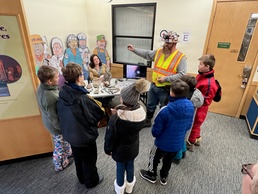
On the crisp winter mornings of Jan. 23 and 29, the quiet, snow-draped landscape surrounding Libby Dam, in Libby, Montana, transformed into a living classroom. For those two days, the dam’s massive concrete structure stood as a silent witness to a much smaller, more animated kind of energy: the Friends of Scotchman Peaks Wilderness (FSPW) 12th annual “Winter Tracks” event.
While Libby Dam’s Visitor Center is closed for the winter, the surrounding U.S. Army Corps of Engineers’ land became the perfect stage for about 200 elementary school-aged students to trade their desks for snowshoes. The event, a cornerstone of the FSPW’s educational outreach, is designed to spark students’ curiosity by immersing them in the ecology of their own wild backyard as they rotate through interactive stations led by expert naturalists and wildlife biologists.
For Libby Dam, hosting the event is a natural extension of the Army Corp’s broader mission. While the dam is associated with flood reduction, hydropower and recreation, it also manages thousands of acres of critical habitat toward environmental stewardship.
“Our mission isn’t just about infrastructure; it’s aboutstewardship,” said Tana Wilson, Libby Dam natural resource chief. “By opening Libby Dam’s landscape to “Winter Tracks,” we’re showing kids that a dam doesn't just manage water—it shares a home with elk, eagles and bears.”
The Army Corps’ commitment to natural resource conservation lends to the FSPW’s efforts to ignite students’ curiosity for the natural world, by providing the perfect backdrop to teach them that enjoying the outdoors and managing resources responsibly go hand in hand. According to Susan James, park ranger at Libby Dam, “Students learn that infrastructure can exist alongside wilderness, and both require care and respect.”
“Winter Tracks” is a major staple among Libby Dam’s outreach activities. Since 2021, Libby Dam park rangers have collaborated with FSPW to inspire and encourage environmental stewardship and conservation among the youth. The partnership highlights a unique connection ofmodern technology and ancient ecology, where students learn how dam water management affects downstream ecosystems, while simultaneously tracking the deer that navigate the snowy banks.
“The biggest win is what becomes possible through teamwork,” said Isabella Manning, Lincoln County outreach coordinator for Scotchman Peaks. “By partnering with Libby Dam, 'Winter Tracks' becomes more impactful than anything we could offer alone. Students are exposed to multiple perspectives: federal employees, local volunteers, scientists, educators and community members. Each perspective is valid, and together they create a richer understanding.”
The event’s curriculum went far beyond textbooks. Under the guidance of experts and educators representing the U.S. Forest Service, Montana State Fish, Wildlife and Parks, as well as local nonprofits, students learn about outdoor cooking, bear awareness, primitive fire making, how to track various animal signs and to identify native trees.
Along with expert educators, Libby Dam’s park rangers explain how the Army Corps protects nesting sites and maintains the health of the Kootenai forest, emphasizing its commitment to theNational Environmental Policy Act, and how local, state and federal agencies work together to ensure man-made marvels coexist with the wild inhabitants of the Scotchman Peaks.
By the end of each day’s event, the students leave their own "human tracks" across the Army Corps property, but with a deeper understanding that Libby Dam is a vital guardian of the Kootenai’s natural heritage.
"The students’ wide-eyed wonder is what inspires us," said James. “It’s about building a community of future stewards who understand the wilderness isn't just a place on a map—it's home."
At its core, partnerships between the Army Corps and organizations that focus on natural resource conservation emphasize the importance of educating the next generation to make informed, thoughtful decisions about the environment.
By working together, with stewardship, safety and education as shared values, USACE and its partners model collaboration – an important lesson students see in action, up close and personal.