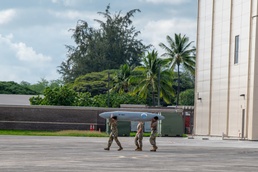
JOINT BASE PEARL HARBOR-HICKAM, Hawaii - Over 200 U.S. Airmen and F-35A Lightning II aircraft assigned to the 115th Fighter Wing, Wisconsin Air National Guard participated in exercise Sentry Aloha 26-1 at Joint Base Pearl Harbor-Hickam, Hawaii, Jan. 14-18, 2026.
Sentry Aloha exercises have been conducted by the Hawaii Air National Guard for more than 20 years. This iteration of the exercise, Sentry Aloha 26-1, focused on providing maximum opportunity for quality ready aircrew program execution in a total force environment. The primary focus is on tactical air dominance through joint fourth and fifth generation dissimilar air combat training involving approximately 1,000 personnel and aircraft from seven states.
Built around DACT, Sentry Aloha challenges pilots to engage in combat scenarios against aircraft with different performance capabilities. Rather than training against identical airframes, DACT forces pilots to adapt to unpredictable engagements, testing their ability to exploit their platform’s strengths while capitalizing on adversary weaknesses.
This exercise included F-22 Raptors and KC-135 Stratotankers assigned to the 154th Wing, Hawaii Air National Guard, MK-59 Hawker Hunters assigned to the Airborne Tactical Advantage Company, Hawaii, F-35A Lightning II aircraft assigned to the 115th Fighter Wing, Wisconsin Air National Guard, KC-135 Stratotankers assigned to the 128th Air Refueling Wing, WIANG, F-15C Eagles assigned to the 159th Fighter Wing, Louisiana Air National Guard, KC-135 Stratotankers assigned to the 155th ARW, Nebraska Air National Guard, C-130H Hercules assigned to the 153rd Airlift Wing, Wyoming Air National Guard, E-3 Sentry AWACS assigned to the 3rd Wing, Alaska Air National Guard, E-3 AWACS assigned to the 552nd Air Control Wing Oklahoma Air National Guard, with support personnel from multiple units, states and partnering countries.
Sentry Aloha provides tailored, cost effective and realistic combat training for National Guard and Department of War counterparts in a joint, multi-faceted, interoperable venue with large overwater airspace, good weather, and HIANG assets for high-end air-to-air training and distributed operations.
“The biggest challenge of training over the Pacific is the ‘tyranny of distance’,” said Maj. Michael Oliver, the Sentry Aloha 26-1 exercise director, assigned to the 199th Fighter Squadron, HIANG. “To get units to Sentry Aloha is a huge logistics effort, and to effectively train in the Pacific requires air refueling, layered long-range communications, and smart planning to make sure units can sustain operations over extended periods of time when material would have to be flown or shipped to Hawaii, taking significant time. The advantage of training in Hawaii is that units get to exercise those tactics, techniques and procedures that the Air Force, and partners would need to use to respond to any contingencies in the Indo-Pacific theater.”
“Participating in these exercises in Hawaii allows for integration with F-22s that we don’t often get,” said Capt. Deagan Muth, the 115th Fighter Wing project officer for Sentry Aloha 26-1. “It provides superior airspace where we can train more closely to how we would in combat, familiarities with PACAF threats, and great tanker support.”