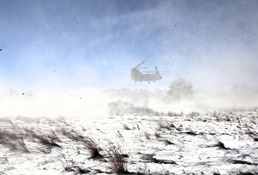
A CH-47 Chinook helicopter and several UH-60 Black Hawk helicopters and their aircrews stepped up to support a winter sling-load training event Jan. 28 at Fort McCoy during some of the coldest temperatures the installation will see for all of 2026.
The crews and helos, all with the 2nd Assault Helicopter Battalion, 147th Aviation Regiment of the Minnesota National Guard (2-147th), were supporting Soldiers with the 1st Battalion, 120th (1-120th) Field Artillery of the Wisconsin National Guard at Firing Point 421 at Fort McCoy.
With helicopter blade wash just increasing the wind-chill factor ten-fold during the training operations, all the cold-weather preparation was a good thing, said Command Sgt. Maj. (CSM) Nick Kletzien, battalion CSM. And the training provided a realistic feeling for what 120th members would have to face in extreme cold-weather conditions possibly somewhere else in the world.
“This was a great opportunity to test our equipment,” Kletzien said. “And a good opportunity to have a training event that’s realistic to what we could face.”
For the sling-loads, the helicopter aircrews were lifting the M119 Howitzer.This training event was completed over several hours. Teams of Soldiers took turns hooking up the sling-load Howitzers to the different helicopters. The helicopters would then pick up the pieces, take them for a short flight, and then return them to the same spot they were picked up from.
The 2-147th has supported training at Fort McCoy in the past in a number of ways in addition to sling-load training. The unit also has a strong history of supporting National Guard units in neighboring states.
According to the unit description at https://minnesotanationalguard.azurewebsites.us/2-147, the Saint Paul-based 2nd Assault Helicopter Battalion, 147th Aviation Regiment “is a National Guard utility helicopter unit that supports the 34th Red Bull Infantry Division and the state of Minnesota by providing airlift, scouting, mobility, and support of civil authorities.
“The battalion has six subordinate units: A Company, D Company, and E Company at St. Paul’s Holman Field as well as B Company in the Kentucky National Guard and C Company in the Iowa National Guard.
When looking at the airframes themselves, an Army fact sheet shows the CH-47 is the Army’s only heavy-lift cargo helicopter supporting critical combat and non-combat operations, according to the Army fact sheet on the helicopter. The CH-47 has an empty weight of 24,578 pounds and a maximum gross weight of 50,000 pounds. The helicopter also can lift intra-theater payloads up to 16,000 pounds in high/hot environments.
The CH-47 Chinook is also one of the most recognizable and dependable aircraft in the inventory of the Army, the fact sheet states. Known for its distinctive twin-rotor silhouette and deep, thunderous rotor sound, the Chinook has served as the Army’s primary heavy-lift helicopter for more than six decades. Built by Boeing, it first entered service in the early 1960s and has remained continuously relevant through steady modernization and mission adaptation. Designed around a tandem, counter-rotating rotor system, the Chinook eliminates the need for a tail rotor and converts nearly all engine power directly into lift and forward motion. This configuration gives it exceptional lifting ability and stability, especially when carrying oversized or externally slung loads.
From a distance, it often appears to move with deliberate strength rather than speed — a flying heavy hauler built to move what other helicopters cannot. Inside its wide fuselage, the Chinook can carry dozens of fully equipped Soldiers, palletized cargo, artillery pieces, light vehicles, and evacuation litters. A rear loading ramp allows rapid roll-on and roll-off operations, making it ideal for air assault insertions, resupply missions, and battlefield recovery tasks.
And according to the Army fact sheet for the Black Hawk, its mission is to provide air assault, general support, aeromedical evacuation, command and control, and special operations support to combat, stability, and support operations.
The UH-60 also is the Army’s utility tactical transport helicopter, the fact sheet states. The versatile helicopter has enhanced the overall mobility of the Army due to dramatic improvements in troop capacity and cargo lift capability over the years as well. Now in its fourth decade of service, the Black Hawk was developed as a result of the Army’s requirement in 1972 for a simple, robust, and reliable utility helicopter system to satisfy projected air-mobile requirements around the globe.
Named after Native American war chief and leader of the Sauk tribe in the Midwest, Black Hawk, the first UH-60A was accepted by the Army in 1978 and entered service in 1979 when it was delivered to aviation components of the 101st and 82nd Airborne Divisions, the fact sheet states.
Learn more about Army aviation by visiting the Army Program Executive Office for Aviation webpage at https://www.army.mil/peoaviation.
Black Hawks and Chinooks from many different units, especially Army Reserve and National Guard units, train regularly at Fort McCoy every year.
Learn more about the Army Reserve by visiting https://www.usar.army.mil. Learn more about the National Guard by visiting https://www.nationalguard.mil.
Fort McCoy’s motto is to be the “Total Force Training Center.” Located in the heart of the upper Midwest, Fort McCoy is the only U.S. Army installation in Wisconsin.
The installation has provided support and facilities for the field and classroom training of more than 100,000 military personnel from all services nearly every year since 1984.
Learn more about Fort McCoy online at https://home.army.mil/mccoy, on Facebook by searching “ftmccoy,” on Flickr at https://www.flickr.com/photos/fortmccoywi, and on X (formerly Twitter) by searching “usagmccoy.”
Also try downloading the My Army Post app to your smartphone and set “Fort McCoy” or another installation as your preferred base. Fort McCoy is also part of Army’s Installation Management Command where “We Are The Army’s Home.”