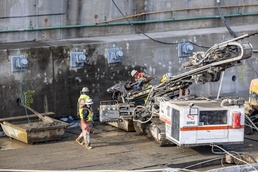
Seismic retrofit work continues on Dry Dock 4 at Puget Sound Naval Shipyard and Intermediate Maintenance Facility (PSNS & IMF), with a targeted completion date now ahead of schedule.
The critical restoration and modernization project, spearheaded by Naval Facilities Engineering Systems Command (NAVFAC) Northwest and part of the Navy’s Shipyard Infrastructure Optimization Program (SIOP), enhances the resiliency of the dry dock against a seismic event, ensuring the Navy’s mission-critical assets remain protected and operational.
The 24-hour, six-days-a-week seismic retrofit project consists of systematically inserting anchors into the perimeter of the dry dock to fortify the walls – sometimes up to 15 a day. Each anchor consists of 12 cables drilled through the dock walls, beyond the drainage layer, into the native soil beneath. The next step involves injecting grout between the cables. Once the grout cures, the team tensions the anchors and locks them into place. Once positioned, the anchors ensure the dry dock can withstand a major seismic event with no more than six inches of lateral movement, the maximum flexural allowance that keeps the walls from striking a docked vessel.
"Seismically retrofitting Dry Dock 4 demonstrates our commitment at the foundry to modernize critical infrastructure to support critical fleet operational requirements," said NAVFAC Northwest Commanding Officer Capt. Preston Taylor. "The team’s hard work procuring and installing the anchors means we are set to complete this crucial project on time and on budget."
It takes all hands on deck – or dock in this case – to make the repairs. Four teams on four separate barges work concurrently in the dock area. Project managers, engineers, craftsmen, woodworkers, lifting and handling experts and many more professionals contribute to the multi-million-dollar effort. The staff structure mirrors that of a vessel repair staff, demonstrating the strong linkage between sound shore infrastructure and a strong fleet.
With limited space on PSNS & IMF and multiple operations occurring, the team learned to navigate competing outage requests, laydown area needs, and interactions between multiple contractors. Understanding how to plan for, integrate and coordinate multiple vendors and projects in a tight space will pay dividends in the SIOP work planned at the shipyard over the next few decades.
After completing significant milestones along the way, the team meets for an after-action review, explaining what they did or what worked well, what did not, and how they can improve in the future. This continuous learning and implementation of best practices helps them find faster, safer, higher-quality ways of performing the work. Geotechnical testing and enhanced modeling resulted in a 40 percent reduction from the initially estimated more than 1,000 anchors down to just 600 anchors. The team drilled test anchors to ensure their strength met the anchor system parameters, tested concrete to determine how much they could safely pre-load, and verified the depth of native soil around the dock. These assessments led to a shift in the anchor’s design and length, resulting in an increase in the pre-load tension that allowed for wider spacing of the pins and a consequential reduction in time and cost.
The successful and accelerated completion of the Dry Dock 4 seismic retrofit, coupled with the new procedures and relationships established since its onset, enables this critical facility to continue to support the maintenance of the Navy's most vital assets and their docking schedule for years to come.