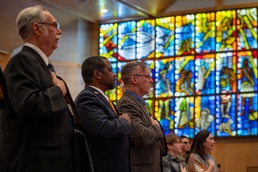
CAMP HUMPHREYS, South Korea — U.S. Soldiers and community members gathered at the Four Chaplains Memorial Chapel, Feb. 3, 2026, to honor the legacy of the four Army chaplains who gave their lives to save others while aboard the USAT Dorchester in 1943.
“These four chaplains gave their life jackets to save four Soldiers and in doing so, gave up their only means of survival,” said Steve Tharp, event emcee. “They were last seen on the deck of the ship with their arms linked together and their heads bowed in prayer.”
At approximately 12:30 a.m., Feb. 3, 1943, during the quiet, dark and cold hours of the night, the USAT Dorchester was torpedoed by a German submarine, causing it to sink with 902 men aboard. Of those on board, 672 paid the ultimate sacrifice.
Among the fallen were a rabbi, a Roman Catholic priest, a Methodist minister and a Dutch Reformed minister, who gave others their life jackets when supplies ran out. These four chaplains were later honored by Congress and memorialized by communities across the country, with one of Camp Humphreys main chapels named in their honor.
George L. Fox initially enlisted in the U.S. Army as a medical corps assistant by lying about his age when he was 17. He was awarded a Silver Star for rescuing a wounded Soldier from a battlefield filled with gas, the Croix de Guerre for outstanding bravery in an artillery barrage and the Purple Heart for wounds sustained in battle.
After leaving the Army, Fox became a successful accountant and a family man before hearing God’s call to the ministry. He then returned to school and was later ordained into the Methodist denomination. When World War II broke out, Fox then rejoined the Army as a chaplain.
“I’ve got to go,” Fox said to his wife before leaving. “I know from experience what our boys are about to face, they need me.”
Alexander D. Goode was an outstanding scholar and athlete. At a young age, Goode demonstrated the bravery that would later define his life by saving his family home along with his three younger siblings by extinguishing a house fire at the age of 11. This young man, full of laughter and promise, followed in his father’s footsteps and became a rabbi. While chasing his calling, Goode joined the Army National Guard and kept an active status before finding his way to the frontlines overseas.
Clark V. Poling was the youngest of the Four Chaplains and the seventh generation in his family to be ordained in the Dutch Reformed Church. When World War II began, Poling immediately volunteered to serve as an Army chaplain, following in his father’s footsteps who did the same thing during World War I. Just before he left for active duty, Poling asked his father to pray for him.
“Not for my safe return, that wouldn’t be fair,” he said to his father. “Just pray that I shall do my duty and have the strength, courage and understanding of men. Just pray that I shall be adequate.”
John P. Washington grew up poor, scrappy and determined, traits that shaped both his character and his calling. Before answering his call to the priesthood, Washington was known as the leader of the South 12th Street gang, a background that later shaped his ability to mentor and guide the youth of his parish. Ordained as a Roman Catholic priest, Washington remained close to his community, often playing ball with the boys of the parish’s organized sports teams.
When war came, Washington chose to go with his “boys,” serving as an Army chaplain. Known for his beautiful singing voice, it is said that in his final moments, Washington’s voice could be heard raised in song and prayer, offering comfort to those around him.
More than 80 years later, the story of the Four Chaplains continues to live on, reflecting a legacy of courage, unity and sacrifice.
Four Chaplains Day, Feb. 3, has been officially observed since it was established in 1998. The ceremony held at Camp Humphreys was one of thousands observed across the nation, a testament to the lasting impact of those four chaplains. The remembrance honors all of the 672 brave young Soldiers who lost their lives aboard the USAT Dorchester, ensuring their sacrifice is not forgotten.
“It is imperative that we teach our children and youth about these great events and great sacrifices, for young people are our future,” said Tharp. “It is vital for them to understand what selfless service on behalf of others can accomplish.”