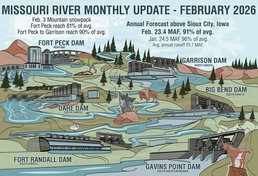
January runoff in the Missouri River Basin above Sioux City was 1.0 million acre-feet, which is 132% of average. Runoff was above average for all of the reaches in the upper Missouri River Basin, even though most of the upper Basin had below-normal precipitation. This was due to above average temperatures causing early snowmelt.
The updated 2026 calendar year runoff forecast for the Missouri River Basin above Sioux City, Iowa, continues to be below average.
“Runoff into the reservoir system was above average for the month of January despite the dry conditions across the basin,” said John Remus, chief of the U.S. Army Corps of Engineers’ Missouri River Basin Water Management Division. “With the below-average plains and mountain snowpack we are forecasting a below-average runoff year for the Basin, resulting in reduced flows from the reservoirs, particularly in the upper basin.”
The 2026 calendar year runoff forecast above Sioux City is 23.4 MAF, 91% of average. The runoff forecast is based on current soil moisture conditions, plains snowpack, mountain snowpack, and long-term precipitation and temperature outlooks.
At the start of the 2026 runoff season, which typically begins around March 1, the total volume of water stored in the Missouri River Mainstem Reservoir System is expected to be 48.9 MAF, 7.2 MAF below the top of the carryover multiple use zone.
Releases from Gavins Point Dam are currently 14,000 cubic-feet-per-second and will remain low during February to continue conserving water in the System, based on the guidance in the Missouri River Mainstem System Master Manual.
“While the target winter release from Gavins Point Dam is 12,000 cfs, releases were increased to 14,000 cfs in mid-January to mitigate some of the effects of the much colder temperatures across the lower basin,” said Remus. “Releases will be held steady until ice effects stabilize downstream of Gavins, at which time releases will be reduced to the winter release of 12,000 cfs. Flows will continue to be adjusted to the extent practical based on cold weather conditions,” said Remus.
Basin and river conditions continue to be monitored, including plains and mountain snow accumulation, and System regulation will be adjusted based on the most up-to-date information.
Navigation: Navigation flow support for the Missouri River is forecast to be at 5,500 cfs below full-service for the first half of the 2026 season, which begins April 1 at the mouth of the river near St. Louis, Missouri. The actual service level will be based on the total volume of water stored within the System on March 15, in accordance with the guidelines in the Master Manual. Flow support for the second half of the navigation season, as well as navigation season length, will be based on the storage in the System on July 1.
Mountain and Plains Snowpack: Mountain snowpack in the upper Missouri River Basin is accumulating at below average rates. The Feb. 3 mountain snowpack in the Fort Peck reach was 81% of average, while the mountain snowpack in the Fort Peck to Garrison reach was 90% of average. By Feb. 1, about 60% of the total mountain snowfall has typically accumulated. Mountain snow normally peaks near April 17. The mountain snowpack graphics can be viewed at: https://go.mil/mr-mtn-snowpack. Additionally, the plains snowpack is below normal in the upper Missouri River Basin.
Monthly Water Management Conference Calls for 2026: The February 2026 monthly conference call will be held Thursday, Feb. 5, to inform basin stakeholders of current weather and runoff forecasts and the planned operation of the reservoir system in the coming months. Presentation materials will be available via webinar. The call is intended for Congressional delegations; Tribes; state, county and local government officials; and the media. It will be recorded in its entirety and made available to the public on our website at https://go.mil/mr-news.
Reservoir Forecasts: Gavins Point Dam
Fort Randall Dam
Big Bend Dam
Oahe Dam
Garrison Dam
Fort Peck Dam
Hydropower: The six mainstem power plants generated 476 million kWh of electricity in January. Typical energy generation in January is 704 million kWh. Forecast generation for 2026 is 7.6 billion kWh compared to the long-term average of 9.3 billion kWh. To view the detailed three-week release forecast for the mainstem dams, go to https://go.mil/mr-3wk-fcast.