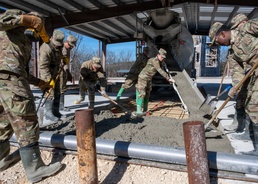
FORT LEONARD WOOD, Mo. — Airmen with Fort Leonard Wood’s U.S. Air Force detachment are putting their new pavement skills to the test by laying concrete at the Urban Search and Rescue training complex — enhancing training for the airmen now and future Homeland Defense Civil Support Office students.
According to John Miller, Urban Search and Rescue Training Department chief, with Fort Leonard Wood’s Homeland Defense Civil Support Office, the airmen placed concrete at the rope rescue and structural collapse breaching areas of the Urban Search and Rescue training complex in Training Area 235.
“The new areas have enhanced our ability to train larger groups of students simultaneously,” Miller said. “It also creates an area where they can observe instructor demonstrations much clearer than before, which will allow students to grasp the task much quicker.”
Air Force Tech. Sgt. Ryan Ritchey, a Pavements and Equipment instructor with the 368th Training Squadron at Fort Leonard Wood, was at the Urban Search and Rescue training complex Jan. 21 helping his students pour a concrete pad for the rope rescue training area.
He said the airmen placing concrete were a week away from graduating from the approximately two-month Pavements and Equipment course, where they learn their military occupational specialty.
“These students are lucky because this concrete placement is for the Urban Search and Rescue Training Department. It gives the students real-world experience,” Ritchey said.
Most of his classes, Ritchey said, place concrete at their own training area that “gets cut up and removed for the next class.”
“When it is for a customer, the pressure is on because they know we expect good craftsmanship,” he added.
Air Force Master Sgt. Logan Thomas, Pavements and Equipment flight chief, with the 368th Training Squadron, agreed and said integrating real-world application projects into the curriculum offers dual benefits.
“Students are refining their attention to detail while contributing sustainable value to organizations around Fort Leonard Wood,” Thomas said. “This approach ensures that student contributions translate into immediate operational improvements for the installation and continue to enhance overall efficiency and readiness long after they have completed our course.”