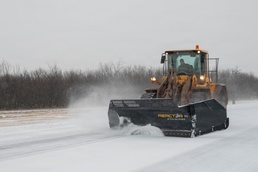
A wintry mix struck Dyess Air Force Base on the second day of the 7th Bomb Wing’s Combat Readiness Exercise, rapidly complicating operations already under pressure. The exercise, dubbed Dark Ascent, began Jan. 22, 2026, and within hours the installation transitioned to Force Protection Condition (FPCON) Charlie.
The shift in security posture immediately compressed timelines and forced Airmen assigned to the 7th Civil Engineer Squadron—commonly known as the “Dirt Boyz”—to execute force protection requirements in parallel with exercise objectives as weather conditions continued to deteriorate.
As precipitation intensified, 7th Bomb Wing leadership paused the exercise to allow a deliberate shift in priorities and formally exited Exercise FPCON Charlie.
“Once the storm set in, it became clear we had to pivot quickly,” said Lt. Col. Jacob Bright, 7th Civil Engineer Squadron commander. “The priority shifted to protecting the installation and setting conditions to restore operations as fast as possible.”
Over the next 50 hours, the storm deposited approximately three-quarters of an inch of ice and two inches of snow, according to Staff Sgt. Gregory Stipes, 7th Operations Support Squadron weather craftsman. The accumulation created a bonded surface that historically leads Dyess to wait for solar melt rather than attempt removal.
Instead of accepting delay, the Dirt Boyz reorganized to reopen the airfield and restore operational access.
Before the exercise pause, the team executed a full barrier plan under FPCON Charlie conditions. Crews emplaced 157 barriers across the installation while deliberately accounting for future snow operations and heavy equipment movement. Additionally, they preserved vehicle turning radii, access routes and staging areas to prevent barrier placement from obstructing recovery efforts.
“That planning mattered,” Bright said. “By thinking ahead, the team avoided rework and removed friction once we transitioned from force protection to recovery operations.”
On Saturday, Jan. 24, the team focused on main base and essential traffic areas. Crews treated roads, intersections and bridge overpasses as snow and ice continued to fall, placing sand at critical locations to allow mission-essential operators, maintenance personnel and emergency services to safely traverse the installation.
Early Sunday, Jan. 25, the Dirt Boyz shifted focus to reopening the airfield in preparation for C-130J Super Hercules operations scheduled two days later.
“We didn’t have the luxury of waiting for ideal conditions,” Bright said. “The team adapted with the equipment available and leaned forward to get the airfield back in the fight.”
The CE team executed the mission without organic snow removal equipment, relying instead on a loader fitted with a box blade, one excavator, one backhoe and two rented 10-foot road construction sweepers.
According to Bright, Texas does not stock snow brooms as standard rental equipment, so the team adapted debris sweepers for snow removal.
“Operators used heavy equipment to break bonded ice while sweepers cleared snow and ice from priority surfaces, managing traction and refreeze risk while temperatures remained below freezing for nearly the entire operation,” Bright said.
Within 48 hours of the storm’s end, the Dirt Boyz reopened the airfield. They established a minimum operating strip measuring 100 feet by 7,000 feet, cleared a supporting taxiway and opened the C-130 parking area. Airfield Management then validated all cleared surfaces and confirmed the airfield was open for flight operations.
At 11 a.m. Wednesday, Jan. 28, five C-130J Super Hercules aircraft departed Dyess AFB.
Bright noted that based on previous winter weather events, the Dirt Boyz’s efforts opened the airfield an estimated three days earlier than a wait-and-melt approach would have allowed.
Later that day, the CE team extended the cleared surface to 100 feet by 13,500 feet, enabling the recovery of combat capability when four F-16 Fighting Falcons declared an emergency fuel divert and landed at Dyess. The Dirt Boyz then rapidly prepared a taxiway, allowing 7th Logistics Readiness Squadron personnel to refuel the transient aircraft and return them to mission status.
“That moment highlighted why speed matters,” Bright said. “Because the airfield was open, we were able to support aircraft in distress and preserve combat power.”
Leadership reinforced success by establishing a centralized command-and-control node within Airfield Management to deconflict snow removal priorities. The node synchronized civil engineer actions, surface status reporting and flying unit requirements in real time.
In conjunction with snow removal operations, the 7th CES director of operations, Maj. Jason Hernandez, activated the 7th CES Unit Control Center to mitigate base wide emergencies and maintain installation resiliency.
“Our engineers were fighting the storm on multiple fronts,” Bright said. “They were clearing the airfield while simultaneously responding to real-world emergencies across the installation.”
Over the six-day storm and recovery period, the unit responded to 17 HVAC emergencies, a base wide water outage, eight fire suppression and domestic water pipe bursts and a small structure fire inside the 7th Security Forces Squadron headquarters building. The fire triggered a full station recall and required mutual assistance from the Abilene Fire Department.
According to Bright, the 7th CES Fire Department’s rapid response limited damage to the source HVAC unit.
The Unit Control Center provided centralized command and control, prioritized life safety, synchronized emergency response forces and ensured no single incident degraded overall mission execution.
Over the course of Winter Storm Fern, Airmen assigned to the 7th Civil Engineer Squadron executed emergency response, force protection, airfield recovery and installation sustainment simultaneously.
“When conditions were at their worst, our Airmen delivered,” Bright said. “They proved once again that civil engineers…lead the way.”