Story by Master Sgt. Shaun Reagan, 104th Fighter Wing Religious Affairs
BARNES AIR NATIONAL GUARD BASE, WESTFIELD, Mass. — The Department of the Air Force has released updates to DAFI 36-2903, Dress and Personal Appearance, through DAFGM 2026-05, with changes effective immediately for the Regular Air Force, Air Force Reserve, and Air National Guard. However, Airmen have until 30 September 2026 to comply with the updated combat boot height standard.
These revisions are not about reinventing the uniform or micromanaging appearance. Instead, they focus on clarifying expectations, closing long-standing gray areas, and reinforcing professionalism, readiness, and mission focus across the force.
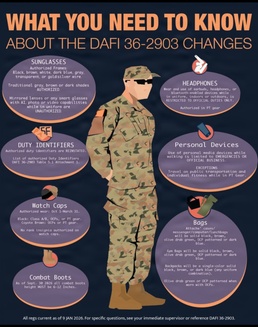
One of the most noticeable changes is the return of OCP duty identifier patches and qualification tabs, which are once again authorized for wear on the left sleeve in accordance with Table 5.1. After a period of confusion and inconsistent interpretation, the guidance is now clear: the patches are officially back.
Officer uniform requirements have also been refined. Officers are now required to maintain only the uniforms necessary to perform their assigned duties and mission, aligning expectations with real-world tasking rather than hypothetical scenarios.
The update also addresses combat boot standards. Authorized boot height is now set between 6 and 12 inches, with a maximum sole height of 2 inches. Recognizing the practical impact of this change, the Air Force has provided a delayed compliance date, giving Airmen until the end of September 2026 to meet the new requirement.
Several updates focus on grooming standards, particularly shaving policies. Commanders now have final approval authority for shaving profiles. Unless an Airman has an approved medical profile or religious accommodation, male Airmen are required to be clean shaven at the start of the duty day.
Medical shaving waivers issued prior to 1 March 2025 will expire on 31 January 2026, and all waivers must be reevaluated by medical personnel. No single shaving profile may exceed six months, and Airmen who accumulate more than 12 months of shaving profiles within a 24-month period will be referred to their commander for a readiness review. For questions or clarification, Airmen are encouraged to contact Lt Col Patrick Lafond, 104th Fighter Wing Medical Squadron, who has been actively assisting units with implementation and guidance. Mustache standards remain unchanged but are clearly reinforced. Mustaches may not extend beyond the corners of the mouth or interfere with a respirator seal, and handlebar-style mustaches remain unauthorized. Male hair standards specify that hair bulk may not exceed 2.5 inches and must not touch the ears. Eyelash extensions are not authorized unless medically documented, and if approved, they must be natural in color and no longer than 12 millimeters. Nail polish, if worn, is limited to clear, French, or American manicure styles.
The update also tightens guidance on accessories and personal items. Mirrored lenses are prohibited, eyewear must be in conservative shades such as gray or brown, and smart or AI-enabled eyewear capable of recording or transmitting is not authorized. Airmen looking for additional context are encouraged to read Mr. Thayer’s article in this issue of Air Scoop. Earbuds and headphones are authorized for official duties only, with personal use while walking limited to emergencies or official notifications. Authorized bag colors include solid black, brown, dark blue, olive drab green, or OCP pattern. Watch caps are authorized in black or coyote brown and may be worn only in appropriate cold-weather conditions.
Personal cell phone use while walking in uniform is restricted to brief, necessary use for official notifications or emergencies. Extended use, such as texting, scrolling social media, gaming, or phone calls, is not authorized. Eating while walking remains prohibited, while drinking beverages while walking is permitted unless otherwise restricted by a commander. Ponytails and equivalent hairstyles remain authorized within established length, bulk, and safety standards, with no changes made in this update. Hands in pockets are also authorized, provided they do not detract from military bearing or interfere with customs and courtesies.
Air Force leaders emphasize that these changes are not intended to make daily life more difficult, but to ensure standards are clearly understood and applied consistently. Clear guidance reduces confusion, supports professionalism, and keeps attention where it belongs, on the mission and on taking care of Airmen. When questions arise, Airmen are encouraged to consult their supervisor or First Sergeant rather than making assumptions, helping prevent misunderstandings and saving time for both Airmen and leadership.