BARNES AIR NATIONAL GUARD BASE, WESTFIELD, Mass. — When winter conditions halt aircraft arrivals and departures, the economic consequences extend far beyond aviation. Corporate travel, sports charters, private flights, and fuel sales are disrupted, while local restaurants, hotels, and businesses that depend on reliable air access, feel the immediate effects.
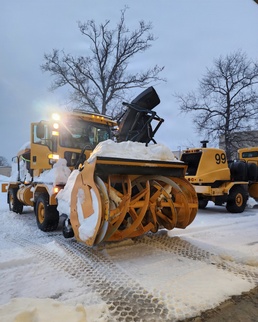
During a major snowstorm on January 25, 2026, while most of the 104th Fighter Wing remained off base, a dedicated team of five Massachusetts state employees stayed on base for more than 48 hours to ensure the runway could be cleared for emergency use. Their mission was critical: keeping the airfield operational in case aircraft needed to land or depart under urgent conditions.
The team works at the 104th Fighter Wing with the Civil Engineering Squadron. They all hold a CDL license. Ryan Ratcliffe, Mark Dion, Pete Derosier, Kyle Kleis, and Brian Salois have been working together for over 19 years.
Jeffrey R. DuBois, MA. State Superintendent at the 104th Fighter Wing, commented on the teams determined dedication to get the job done. “They know how to work together, without question”, said DuBois. “They are extremely flexible, one of the best teams I have known and they just get it done!”.
Westfield–Barnes Regional Airport relies on the 104th Fighter Wing to clear the primary runway and select ramp areas, making close coordination essential.
“The 104th Fighter Wing is a critical component of our community and our airport,” said Daniel Shearer, Westfield-Barnes Regional Airport Manager. “During the winter, the 104th provides additional snow removal assets, specialized equipment, and skilled personnel that significantly enhance our capabilities.”
Responsibilities are clearly defined between the two teams. “We each have a section to do,” said Ratcliffe. “Everybody knows their part. The 104th is responsible for the Gulf Taxiway, North, Bravo onto Runway 20, the South Arm, and then returning back. The airport handles Bravo Taxiway, Echo, Hotel, Foxtrot, Alpha, and Delta.”
This coordination allows snow removal operations to move quickly and efficiently. “We’ve been doing this so long that it’s second nature,” Ratcliffe added. “It’s like one big team with the city, we take over from one area, they take over from another, and we meet in the middle.”
“During the last storm, we had an aircraft land fully covered in snow,” Dion said. “The landing went fine, but when the pilot needed to take off, we had to go right back out and clean the runway again.”
Even minimal snow accumulation presents safety risks. “A thin layer of snow or ice can significantly reduce aircraft traction,” Shearer explained. “Snow must be completely removed and pushed well clear of the pavement to prevent obstructions.”
The team noted that storms of this magnitude are rare. The last comparable event occurred nearly ten years ago, when fighter jets were still parked on the ramp.
“Back then, we wouldn’t wait for six inches of snow,” Ratcliffe said. “We’d be out there with just a dusting, nonstop.” Preparations began days before the storm, with crews fueling vehicles, each truck carrying up to 200 gallons of fuel, performing functional checks to ensure all equipment is working properly, and producing deicing fluid on site.
“Two hundred gallons of fuel will last about 20 hours before refueling,” said Dion. “If we need more, it’s available on base and can be transported to the flight line if necessary.”
Equipment bays were fully stocked with two snowblowers, four plow trucks, and four brooms. Although plans called for at least three plow trucks and two snowblowers, all equipment was prepped and ready. This readiness was essential, as the runway must be cleared to support emergency operations and ensure safe aircraft movement. In addition to snow removal, the team is responsible for runway deicing.
“We use a non-salt-based product called sodium acetate,” said Derosier. “Salt causes corrosion on jet engines and aircraft components. Sodium acetate does not, making it safer for aviation operations.”
Ratcliffe has taken on the additional duty of making the deicing liquid on base saving time and money. The product is ready when needed.
NEWDEAL BrineX is the product used on the airfield. “It involves taking NEWDEAL ice melting pellets and mixing it with water to create what we call “CE Home Brew”, “said Ratcliffe. Dubois confirmed that the product is FAA approved and tested.
While winter weather limits recreational flying, it coincides with peak sports charter season. “This is the height of our sports charter traffic, including UMass football and basketball and their visiting teams,” Shearer said. Without the support of the 104th, snow removal would take longer, reopening would be delayed, and staffing costs would increase significantly.
This long-standing, mutually beneficial partnership between the 104th Fighter Wing and Westfield–Barnes Regional Airport ensures the airport remains operational through most winter storms and can return to normal operations quickly. Most importantly, it guarantees that both civilian aviation and military aircraft are ready to respond at a moment’s notice, when the community and mission depend on it most.