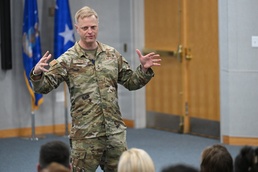
The Department of the Air Force Portfolio Acquisition Executive for Command, Control, Communication and Battle Management, has departed the organization -- closing a chapter marked by rapid transformation, operational urgency, and a focus on delivering capability to the warfighter.
As Lt. Gen. Luke Cropsey transitions to his new role as military deputy for the Office of the Assistant Secretary of the Air Force for Acquisition, Technology and Logistics, he reflected on DAF PAE C3BM’s growth into a more integrated, mission-focused organization capable of delivering complex capabilities at speed.
Looking back on your time leading PAE C3BM, what accomplishments are you most proud of, and what efforts do you hope will endure?
“There are many things our divisions have accomplished that I’m proud of. I’m super excited about where the integrated product teams landed, both from a mission increment standpoint and from a stack perspective, and how the strategies each of them built over the last year are starting to focus and coalesce the whole enterprise around what right looks like.
The second piece of that is how we are converging the broader enterprise around a set of capabilities that will allow us, in the long term, to be able to move faster and scale the way that we need. Not theoretically, not as a science project, but a no kidding, you guys got capability delivered. I think, if nothing else survives going forward over the next couple of years, but that does, then we'll win at the end of the day.”
You've been here from the beginning and basically built the organization as we have it now. What about this situation made this a unique assignment and challenge for you?
“There is a structurally unique aspect to who we are. There’s the fact that we have an Architecture and System Engineering team who is focused entirely around doing the mission engineering that's required to actually map out and close kill chains. That didn't exist when we started with the problem that had to be solved. That was a challenge Dr. Bryan Tipton and I had to figure out: 'what mission engineering is designed to elicit.' So that was, and continues to be, totally unique about how C3BM is organized. We also have an Operational Response Team, which is another completely unique aspect of who we are, because we have an entire division that's dedicated to getting after, in real-time, the kinds of things that need to go down and exercise as experimentation.
I think there are also things that are underneath that. When we start talking about culture, the way that we want people to think, the speed at which we want them to act, the risk that we're willing to take ... those are the maybe not so obvious things that don't show up on the org chart that are, if anything, even more important because with the right culture we have the right people thinking the right way about what we have to do and how we have to get after it.”
How has C3BM evolved technically, organizationally and culturally?
“Well, when we started out, we were a merry band of about 200 people and there was one program. We largely relied on a combination of the Rapid Capabilities Office, the Air Force Research Lab, and the Air Force Life Cycle Management Center for most of our overhead that goes with an organization, along with a small contingent of dedicated Guardians out in Los Angeles. We didn't have any of our own functionals. We didn't have our own front office. We didn't have any of that. We were running as fast as we could, and we were able to get some stuff done, but if you want to scale, you need to figure out how to get more hands involved.
Two years later we went from those 200 people to about 3,000 people. We really had to figure out, in fairly rapid order, how we expand the scope of what we were doing to accommodate that growth. I think we have one of the largest scoped PAE programs, or portfolio acquisition executives, which introduces another set of challenges trying to figure out how we get after delivery at speed more efficiently and effectively.”
C3BM operates in a complex and fast-moving environment. How did you balance speed, innovation and risk while delivering capability to the warfighter?
“We have a higher appetite to take on risk, some days more successfully than others. We've got to learn the lessons from those things, so we don't keep repeating them. The whole premise of doing rapid iteration is learning along the way, making the adjustments on the next one ... that's what we're built on. If we can't provide the team enough top cover for them to take those risks and have those failures, then we're not actually going to change the rate at which we're capable of delivering.”
What advice do you have for your successor for the next phase of C3BM’s mission growth and success? And if you were to leave them a note in your desk, what do you tell someone taking the hardest job in the Air Force?
“I think ‘strong opinions loosely held’ is important. Having a clear view of where you think things need to go but being open and willing to make the adjustments as you get better information along the way. Dr. Tipton and I didn't know whether or not what we were doing was going to work, we just knew what didn't work over the past three decades. We were willing to try something different and then adjust as we went.
If you look at the last three years, you could sum them up as basically a sea of adjustments that we have made, quarter over quarter, as we got feedback over the things that were landing and things that weren't. To be successful in this position you've got to be willing to keep things open, even when the natural tendency is to clamp down on things when they’re chaotic, ambiguous and uncertain. We need more ideas, not less ideas. The point that I made earlier about rapid iteration where we're learning as we're going; if that's not baked into your operational model, I don't know how you’d get out of analysis paralysis in this job.
I'd say there are some areas that we've been operating fast and loose in and probably could use a little bit more structure. There's a time and a place for everything in these instances. There is probably some tension in the system around the speed at which we want to be able to go and the ability to get an organization at scale engaged on the problem. Balancing that tension, I think, is going to be something that my successor is going to have to figure out in a different way than I have over the last three years.”
If you had one more year, what would you focus on?
“Fight tonight.” What are the tangible concrete systems that we can get out the door and into the field right now that would help in a fight. We're getting after those things, we have a list of them, we have pushed that list out to our operational counterparts, and we've asked them if we're getting it right in terms of what we're prioritizing. We’re actively taking that feedback to pivot where we need to. Between now and next December, we have the opportunity to fundamentally transform the way the broader team, the Air Force and the Space Force, in particular, think about how they do command and control.
The other thing is, we must get the IPTs functioning to the point where the whole enterprise sees those IPTs as the synchronizing mechanism for that content independent of what organization you're from or what product you're building. There has to be recognition and delivery out of those IPTs on those mission increments and on those stack strategies. If I was here for another year those two things are what I would double down on. That's exactly where my head would be.”
What parting thoughts do you have for all of C3BM as they continue building on the foundation you helped establish.
“It has been an absolute privilege of a career having the opportunity to lead and to serve with the C3BM Square Peg team. We have some of the leading brains on the planet when it comes to what the future looks like, both in the technology space and quite frankly in the application of that technology to the C2 mission area. We have incredible people on amazing teams that are doing the impossible every single day. So, I feel fortunate and have a ton of gratitude for the opportunity to have been in the seat when I was.
In this PAE, in the context of what we're doing in C2, we have such a dynamic mission space. The technology is evolving at such a rapid pace. The threat is moving so quickly that if we don't stay nimble, agile, and flexible around what we're doing and how we're doing it, we're going to lose in the system that, quite frankly, is not designed to move at half the speed we need it to. So that “Square Peg” mantra is going to continue to be something that I keep going back to. C3BM in the acquisition space is going to have to stay flexible if we want to deliver on the lethality that a future war will require of us. As my Senior Enlisted Leader says, we are going to have to ‘Forge the Lightning and Deliver the Storm!’”