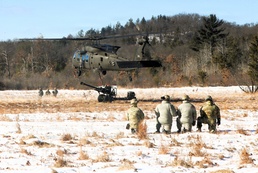
With one CH-47 Chinook and three UH-60 Blackhawks from the 2nd Battalion, 147th Aviation Regiment supporting, Soldiers with the 1st Battalion, 120th (1-120th) Field Artillery held cold-weather sling-load training Jan. 28 at Firing Point 421 at Fort McCoy.
Because the focus was to operate during cold weather, Mother Nature didn’t disappoint as temperatures were as low as -10 degrees Fahrenheit at the start of the training. Soldiers with the 120th prepared for the event, setting up a couple of Arctic 10-person tents with heaters.
Soldiers also donned their Army Extreme Cold-Weather Clothing System, or ECWCS, that’s issued to Soldiers. The system includes a lightweight undershirt and underwear, midweight shirt and underwear, fleece jacket, wind jacket, soft shell jacket and trousers, extreme cold/wet-weather jacket and trousers, and extreme cold-weather parka and trousers.
“It’s a layered system that allows for protection in a variety of climate elements and temperatures,” said Fort McCoy Central Issue Facility Property Book Officer Thomas Lovgren, who’s facility manages the ECWCS distribution for Army Reserve members. “Each piece in the ECWCS fits and functions either alone or together as a system, which enables seamless integration with load-carrying equipment and body armor.”
With helicopter blade wash just increasing the wind-chill factor ten-fold during the training operations, all the cold-weather preparation was a good thing, said Command Sgt. Maj. (CSM) Nick Kletzien, battalion CSM. And the training provided a realistic feeling for what 120th members would have to face in extreme cold-weather conditions possibly somewhere else in the world.
“This was a great opportunity to test our equipment,” Kletzien said. “And a good opportunity to have a training event that’s realistic to what we could face.”
For the sling-loads, the helicopter aircrews were lifting the M119 Howitzer. According to Army facts about the Howitzer, the M119 is alightweight, 105mm towed artillery piece used by the U.S. Army for mobile fire support, based on the BritishL119 gun, known for being air-transportable by helicopter or parachute and towed by Humvees, with upgrades like the M119A3 adding digital fire control for increased accuracy and effectiveness in rapid deployment scenarios.
This training event was completed over several hours. Teams of Soldiers took turns hooking up the sling-load Howitzers to the different helicopters. The helicopters would then pick up the pieces, take them for a short flight, and then return them to the same spot they were picked up from.
According to U.S. Army training manuals, Army sling load operations enable rapid transport of equipment via helicopters, such as the UH-60 and CH-47, to remote or hard-to-access areas. This effort involves three key elements — the supported unit (rigging), the aviation unit (lifting), and the receiving unit. These operations are critical for sustaining forces, enhancing mobility, and delivering supplies when ground methods are hindered.
There are also three phases to sling-load operations. First is inspecting and preparation. Cargo is prepared and inspected for safe air transport, including rigging nylon ropes or chains to equipment like Humvees, artillery, or supply containers.
Second phase it the hook-up: Ground crews — a hook-up team — secure the load to the helicopter using reach pendants, ensuring all attachments are secure, and guide the aircraft if necessary.
Third phase is inspection and release. Here, a certified inspector reviews the load, and upon arrival at the destination, the load is released from the aircraft.
Staff Sgt. Dylan Baird, one of the 120th Soldiers training during the sling-load event at McCoy, said sling-load training is not something they do very often, especially in extreme cold temperatures.
“This is to help us get proficient,” Baird said in a video interview by Greg Mason with the Fort McCoy Multimedia-Visual Information Office at https://www.dvidshub.net/video/994442/sling-load-operations-fort-mccoy-wis. “It’s really nice opportunity because when you think of artillery … this definitely doesn’t come to mind. It’s not something we do very often. It’s a big morale booster, so it’s really nice to just get hands on and have the actual training on how this stuff actually works.”
Kletzien said the 1-120th has done a lot of cold-weather related training in recent years supporting an exercise at Camp Grayling, Mich. But this year, with many of the battalion’s members supporting deployments and off at training schools, they decided to complete a smaller, similar version of the Grayling training during January at Fort McCoy. The 1-120th held their training on post from Jan. 21-31.
Also, sling-load training is a regular activity at Fort McCoy. Students in the 89B Ammunition Supply Course at Regional Training Site-Maintenance hold sling-load training with ammunition pallets several times throughout the year.
Sling-load training has also been a part of many major exercises at Fort McCoy in the past number of decades on post.
Fort McCoy’s motto is to be the “Total Force Training Center.”
Located in the heart of the upper Midwest, Fort McCoy is the only U.S. Army installation in Wisconsin.
The installation has provided support and facilities for the field and classroom training of more than 100,000 military personnel from all services nearly every year since 1984.
Learn more about Fort McCoy online at https://home.army.mil/mccoy, on Facebook by searching “ftmccoy,” on Flickr at https://www.flickr.com/photos/fortmccoywi, and on X (formerly Twitter) by searching “usagmccoy.”
Also try downloading the My Army Post app to your smartphone and set “Fort McCoy” or another installation as your preferred base. Fort McCoy is also part of Army’s Installation Management Command where “We Are The Army’s Home.”