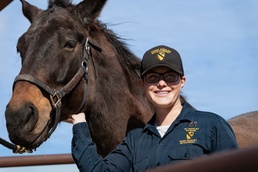
FORT HOOD, TX- Captain Megan Korpiel learned long ago that leadership is not about force. It is about patience, awareness, and timing. Those lessons didn’t all come from an Army manual or a leadership course. They came from horsemanship.
“Everything I’ve learned about myself, I learned from my horses,” Korpiel said.
Horsemanship was the subject of her college application essay, and today it guides how she commands the 1st Cavalry Division Horse Cavalry Detachment.
The 1st Cavalry Division Horse Cavalry Detachment was officially established in 1972, serving a unique mission that blends heritage, public engagement, and Trooper development.
Korpiel began riding horses at age five and competing by eight. Horses quickly became the center of her world. She joined 4-H, a youth organization similar to Scouts, where members develop leadership skills, public speaking ability, and responsibility through hands-on work. From an early age, she assumed leadership roles within her clubs, often representing them at competitions and county fairs.
At age 10, her parents bought her first horse. It came with conditions. “They told me, ‘This horse is your responsibility,’” Korpiel said.
While her parents covered major expenses, the day-to-day care was her responsibility. Feeding, training, and grooming her horse became part of her routine. From age 10, until she joined the Army at 22, caring for horses was her “full-time job”.
Her riding career grew more competitive as she got older. In high school, she trained green, inexperienced horses, preparing them for riders who lacked the knowledge or the means to do so themselves. Working with multiple horses taught her to be a better rider and added skills to her “toolkit”.
One of her most formative experiences came through the Interscholastic Equestrian Association, where riders are assigned unfamiliar horses just moments before competition. “You literally pick a horse from a hat. You get no time to warm it up, and then you go, and you show that horse. So you're judged on how well you can ride that mount with virtually no experience on the horse's back,” said Korpiel.
When applying to colleges, none had a horseback riding scholarship. Although the college Korpiel chose did not have an equestrian program, she started one. She continued riding throughout college and after joining the Army.
Those years taught her lessons she now applies to leading Troopers, and Korpiel believes that awareness carries directly into being a great leader.
“Horsemanship and leadership are very similar,” she said. “The small nuances of learning when to apply pressure, and learning when to take it off translates to leadership and being in tune with your emotions and your body language.”
Korpiel went on to say that, as one of the oldest horse detachments, they’ve had the most time to develop techniques and the most time under their belts to establish best practices. That uniqueness presents challenges.
“Every single problem that we face, no one else has faced before, and so as a commander, my job is to provide the right resources to my Troopers, the right management of tasks, and then provide recommendations,” Korpiel said. “I'm a big problem solver, so it's kind of fun to be able to track down how to get that done.”
Horse selection for the detachment follows strict criteria rooted in tradition. Preferred mounts are American Quarter Horses that are dark in color and within a specific height range. The uniform appearance reflects historical cavalry standards.
All horses must be saddle-broke and trained to walk, trot, and canter. From there, they are trained to handle gunfire, cannons, formations, and crowds. Developing those skills requires careful pairing.
“How we typically do that is, we pair a horse and an experienced rider together, and then they can mesh and match. It's a really cool thing to see, because that Trooper takes so much pride in that horse, and in developing that horse,” said Korpiel.
The Troopers themselves are volunteers. Many arrive with no riding experience. Before being accepted, they complete thirty days of schooling, pass a written test, and present a barn tour with the command team.
Within 18 months to two years, many become capable riders and skilled horsemen.
“We’re not professional rodeo athletes,” Korpiel said. “ But we do our best as a command team with our training program to implement the correct equestrian skills for both riding and horsemanship.”
Korpiel’s command philosophy is built on three principles: be respectful, work hard and do the right thing, and be honest. “I firmly believe that everything else can be figured out after that, if it doesn't fall into one of those three categories,” she said.
Her goal is to produce a formation that can be relied upon and a legacy of Troopers defined by respect, competence, and honesty. Public visibility remains an important part of the detachment’s role. Korpiel hopes people who see the unit in action feel inspired.
“I hope they look at us and they say, ‘I want to be part of the cavalry. Whether that's actually on horseback, a tank, or in a helicopter.” Korpiel said. “I hope that when they look at our organization, they want to be part of the United States Army.”
When asked to describe commanding the Horse Cavalry Detachment, Korpiel did not hesitate.
“Leading the charge.”
For Korpiel, it is a phrase that reflects both tradition and forward momentum. From the barn to public engagement, and everything in between, she continues to lead the way she always has, leading the charge by pushing forward progress for the sake of the horses and her Troopers.