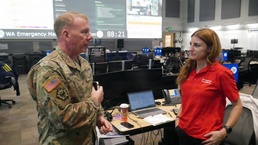
Two weeks of relentless atmospheric rivers inundated Western Washington in December 2025. Rivers swelled to historic levels, threatened homes, industrial areas and stressed communities in floodplains. When the U.S. Army Corps of Engineers (USACE) Seattle District, ramped up its emergency operations, a small, specialized group of individuals stepped into one of the most critical and least understood roles in disaster response: the liaison.
Unlike other highly visible roles during a flood fight, liaisons do not operate the dams or fill the sandbags. Instead, they serve behind the scenes acting as translators, problem-solvers and relationship-builders.
During December 2025’s historic flooding, three USACE Local Government liaisons with different day-to-day job duties volunteered to embed themselves as trained liaisons throughout the Puget Sound area. Tessa Rough, Montgomery Biggs and Paul Fleming used their collective flood-fight experience and training to bridge the critical communications gap between government officials and local leaders during a crisis.
“You’re the single source of truth,” said Rough, a Seattle District regulatory project manager. “You are the hub for all things Army Corps of Engineers.”
From Chaos to Coordination
Local, state and federal agencies worked alongside various Emergency Operations Centers (EOC) throughout the region, the beating hearts of the coordinated response.
Rough, became a critical communications resource as information changed by the minute. For 12 hours a day, she managed a torrent of information, ensuring everyone stayed connected.
“I’d describe it as an old-fashioned telephone switchboard,” said Rough. “You’re taking calls from every direction, and you’re trying to route them to the right person.”
In this environment, the liaison’s desk is the primary touchpoint for all things USACE. When a local or state official needs to understand how dam releases will impact downstream communities, or when a local authority needs flood-fighting supplies, the first stop is the liaison. They are the initial filter and primary director of traffic for a complex web of information.
This helps avoid a fatal flaw of many large-scale responses: communication breakdown. Without a single, trusted point of contact, requests can get lost in the shuffle, information can become outdated and a community in crisis can feel like its calls for help are going into a black hole. To manage this, a liaison must be organized and relentless.
“You’re tracking everything,” noted Rough. “Every request for information, every action, every update.”
The job is more than data management. It requires a deep sense of intuition, empathy and sensing the urgency in someone’s voice. “It’s a lot of listening,” she said. “You have to be a really good listener.”
In the end, a liaison’s most important function may be to provide stability. As Rough puts it, “It’s about being that steady hand, that calm voice in the storm.”
The “Right Stuff”
The consensus among the three was that their success as liaisons was due in large part to having a unique blend of skills that go far beyond formal liaison training.
Rough explained that her training could not replicate a live crisis, where quick, empathetic communication is just as important as procedural correctness.
"The training prepares you for the black and white: the process, the forms, the 'how-to,'" she said. “What it can’t prepare you for is the human element—the exhaustion, the stress and the feeling of being a human switchboard in a live crisis."
As Rough’s “switchboard” analogy illustrates, a liaison is the information keeper and must be adept at multitasking and organization. They meticulously track every request, action and outcome, ensuring that nothing falls through the cracks.
A liaison must also be a skilled communicator. They must listen more than they talk to understand the true need behind a frantic request. They translate highly technical engineering data into plain language that a mayor or county executive can use to make difficult decisions.
“I joke with people and say we’re bilingual,” explained Fleming. “We speak English and ’Government’ [language], telling people in very plain language how to get the help they need.”
Most importantly, a liaison must possess a deep well of empathy and a calm demeanor. They see stress, fear and exhaustion up close. A good liaison remains a steady, reassuring presence, building confidence and showing communities they are not alone.
While the hours were long and the work was grueling, all three felt the positive impact of their work.
“It’s very rare we end up leaving a person high and dry,” said Biggs, a Seattle District park ranger and project manager. “I can’t think of too many times where I’ve had to tell a person, ‘Yep, sorry, there’s nothing I can do to help you.’”
But preparation is key, and the foundational work is the government-to-government connection.
“We can’t simply show up and start working; a formal request must be initiated by a local or state official,” said Fleming. “If the public has a need, they must communicate it to their local leaders, such as their mayor or county emergency manager, because those officials ‘hold the key’ to unlocking USACE assistance.”
Building Bridges Before the Flood
While Rough managed statewide information flow, Biggs, embedded with the Skagit County EOC, one of the first and hardest-hit regions. His experience highlights a different, more proactive side of the liaison role: the power of relationships built long before a disaster unfolds.
“I call it professional speed dating,” Biggs said with a laugh. “You’re meeting everyone you might need to work with in a crisis, but you’re doing it before the crisis hits.”
This pre-established trust is not just a pleasantry; it is a strategic asset. In an emergency, time is the most precious commodity. When local leaders already know and trust their USACE counterpart, conversations are faster, decisions are made with more confidence and resources are deployed more efficiently.
“When you have to call a county executive at 2 a.m., you want them to know your name,” emphasized Biggs. “Trust is everything.”
This work requires more than technical knowledge; it requires a genuine understanding of and respect for the local community. Federal aid that ignores local nuances is often no solution at all. A good liaison knows they are guests – there to support, not to take over.
Biggs explained that to use USACE’s resources effectively, USACE needs to understand a community's specific needs and vulnerabilities beforehand. Building relationships during "peacetime" is what ultimately saves lives in an emergency.
“You have to understand the local landscape, the history, the ‘politics,’” Biggs emphasized. “You can’t just come in and say, ‘Here’s the federal solution.’ You must work with the community.”
A Fresh Perspective
The scale of the December floods was so immense that Seattle District put out a call to sister districts for liaisons. Fleming, a seasoned computer-aided design/building information modeling technician, answered the call from the St. Paul District in Minnesota. He deployed to the King County EOC, bringing a fresh set of eyes and a wealth of experience from battling floods in the Midwest.
Fleming shared that he felt lucky to be in his position after years of “watching from the sidelines.”
“I’ve been with the [liaison] cadre for about five years now,” Fleming explained. “I was a backup until one day I happen to get the call to step up, and now I’m thankful for the opportunities and deployments enabling me to be that support mechanism. It’s everything I thought it would be.”
His presence underscores a key strength of the nationwide USACE network. An outside expert can often see a problem from a new angle or offer a solution that has worked in another part of the country. They are unburdened by local history and can offer objective, technically-sound advice.
“I deployed to be a force multiplier,” said Fleming, “to bring in an outside perspective and maybe a solution they haven't thought of.”
While Fleming worked with Washington State’s most populous county, Biggs worked with the smaller and hard-hit Skagit County, helping the public navigate the formal and often daunting process of requesting federal assistance in – explaining the difference between technical assistance, where USACE provides expertise, and direct assistance, where USACE can provide supplies or manage contractors for emergency repairs.
“I had the luxury of being tied in disaster response organizations like Red Cross, United Way,” he explained. “And my job was not only to tell them what the Corps of Engineers can provide, but to guide them to other available resources.”
For Biggs, the long hours and high-stress environment were made worthwhile by the results of his work. “Being a good liaison is knowing who you’re there to serve, the people” he said. “It’s a tremendous privilege to serve the people and be in a position to help improve people’s lives.”
Rough’s, Biggs’ and Fleming’s joint experiences paint a clear picture of this essential role. The liaison is the human hardware that makes the entire communications system work. They are part switchboard operator, part translator and part trusted guide. Ultimately, they help ensure that in a time of crisis, no call for help goes unanswered.