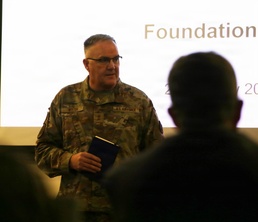
Military and civilian leaders convened at Camp Murray on Jan. 29, 2026, as the Washington National Guard, with support from the National Guard Bureau and U.S. Northern Command, hosted a Foundation Day event focused on homeland defense. The discussion centered on how the National Guard could be employed during large-scale disasters and emerging threats, and the Guard’s expanding role in ensuring the safety and security of the nation.
“I would say this is an interesting time in our country. When I applied for the TAG job and made the argument that this was the most dangerous time in my 36 years in the military, well now I am at 38 years and it is more dangerous,” said Maj. Gen. Gent Welsh, the adjutant general, Washington National Guard. “The new National Defense Strategy focuses directly on the homeland and homeland defense. We have a strategic vision for the homeland coupled with the lowest levels of trust. And this is the space we are colliding with right now.”
The agenda centered around how the National Guard could potentially be utilized to defend the homeland from large scale disasters and unforeseen threats, as well as the role the Guard has in the overall safety of the nation. The event drew representatives from U.S. Northern Command, the National Guard Bureau, Gov. Bob Ferguson’s office, the Washington National Guard, I Corps, Washington Emergency Management, the Washington State Guard, the Department of War, and multiple disaster preparedness and homeland defense partners.
Historically the Guard’s homeland response missions were focused on the yearly traditional threats like natural disasters to include floods, fires, hurricanes, and snow storms. In recent years, the Guard’s homeland missions have expanded to defending against cyber threats, pandemic response and assisting with voting center protection. That doesn’t even account for potential outsider threats from other nation states and the use of foreign objects like drones.
“The idea of foundation day came up only about six months ago, but NORTHCOM knew looking at the current environment that they needed to start working through the problems early,” said Mike Holly, a former North Dakota National Guardsman that now works with Northern Command in the Joint intelligence office. “You guys have a luxury that other states do not when you are thinking about large scale devastating domestic operations response, with this thing called the Cascadia Subduction Zone, that would be a large scale disaster you have already been planning for. So you guys have already started thinking about the worst case scenarios for a while.”
National Guard Bureau and NORTHCOM have been partnering for some time in this environment, looking at large scale disasters.
“A few years ago we started the dual status commander program,” said Holly.
A dual status commander is an officer of the Army National Guard (ARNG), Air National Guard (ANG), or a commissioned officer of the Regular Army or Regular Air Force who has completed specialized training and certification. DSCs are jointly managed by the commander of U.S. Northern Command and the chief of the National Guard Bureau and may, by law, serve in two statuses (federal and state) simultaneously. The president and the governor of the state must both agree to the establishment of a DSC. DSC appointment can be terminated by the Secretary of War or the governor at any time. The National Defense Authorization Act (NDAA), signed in December 2011, facilitated the use of DSCs to provide unity of effort between state and federal forces in achieving common objectives in a disaster response or in supporting a national event.
The speakers at Foundation Day have long been engaged in homeland defense efforts. One of the key speakers was retired Gen. Frank Grass, the 27th Chief of the National Guard, who served from 2012 to 2016. During his tenure as chief, Grass drew on his experience as the former deputy commander of U.S. Northern Command to strengthen the Guard’s role in disaster response and domestic security, elevate the Guard as an operational force, align training and equipment standards with active components, modernize the force, and expand cyber capabilities across the National Guard.
“While we are kind of at the starting point with this, we do have the right people in the room for the conversations,” said Grass.
Another speaker, Dr. John Garver, shared his knowledge and expertise on the emerging threats and why events like Foundation Day are so critical to national security.
“We call this foundation day because it is focused on laying the foundation of how these events go, so when a situation happens we already have a start point. It is important to build relationships and trust with each other,” said Garver. “The most important part of the day is actually the conversations that are happening among us.”
Ultimately foundation day is focused on giving participants a chance to discuss homeland defense and resiliency within their state, as well as facilitate a common understanding of definitions, topics and issues. It also reinforces doctrine and that in any disaster, the governor and adjutant general are the starting point.
“In Washington we are hyper vigilant and hyper-sensitive to what is happening with the military within our states. So I want us to think through these things as we set the foundation for our guard,” said Welsh.