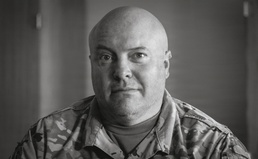
BAUMHOLDER, Germany - The first photo Sgt. Glenn Brennan took that made him feel something wasn’t taken on a battlefield or during a mission. It was at the Bronx Zoo in his native New York City.
In 1987, as a diplomatic gift, China loaned two giant pandas to New York City from the Beijing Zoo. It was a highly popular special exhibit that only lasted six months and drew a million visitors.
Among those visitors was 11-year-old Brennan who was handed a 35mm film camera by his father. He remembers pointing it at the pandas.
“It was one of the first photos I ever took,” said Brennan, now a public affairs specialist deployed here with the 109th Mobile Public Affairs Detachment. “It was an old film camera so I had to pick every shot very carefully.”
In that moment he was a boy trying to capture something rare and fleeting. The pandas were temporary, a moment the whole city talked about, and capturing them made him freeze something important. Long before he ever documented Soldiers, he learned that a photograph could outlast the moment that created it.
Photography became the thread that tied together many chapters of Brennan’s story, even when the chapters didn’t make sense at the time.
“I did it out of enjoyment,” Brennan said. “I went to college for it. Once you do it as a job, it kind of gets a little repetitive, I guess.”
He bounced between roles including forensic photography, portrait studios, construction documentation, odd jobs or anything else that kept a camera in his hands. Those years were scattered, but the camera was the one thing that never left him. Every job taught him something different. Photography became the way he navigated the world, even when the world didn’t give him a clear direction.
“I did forensics, I worked at Picture People, I worked for my father. I would do documentation for people doing interviews,” Brennan said. “They didn’t use my photos, they used a video, but at least I got a thousand dollars out of it.”
Despite a complicated relationship, his father, a photography business owner, taught him the technical foundations, like rule of thirds, angles, lines and perspective.
“He would talk to me about photography, the angles, the light, what to look for,” Brennan said. “I still remember those lessons.”
His father’s lessons stuck. Not just about photography, but about life. His father was not known to offer praise, but he did offer standards. In a way, photography was one of the few languages they ever shared.
“Don’t make excuses. Don’t say ‘um.’ Don’t mumble. Don’t lie,” Brennan said, recalling lessons his father passed on to him.
Brennan still carries those early lessons every time he lines up a shot, even if the relationship behind them was complicated.
He carried those lessons when he joined the Army as well. He enlisted in 1997 as an infantryman and attended Infantry One Station Unit Training, a consolidation of basic training and advanced specialty training, at Fort Benning, Georgia.
During those four months of OSUT, trainees endured and persevered through tough training. The culmination of which was family day and graduation. Every trainee looked forward to the day when they could finally see their loved ones again and share such a proud moment with them.
No one was there for Brennan.
“They were supposed to come, but they never did,” Brennan said. “When I got home, my father didn’t congratulate me. He’s like, ‘okay, go paint the house.’”
Moments like that can leave a mark. Brennan said he holds no hard feelings over it but he learned that recognition wasn’t guaranteed, even when you earn it. You show up, you do the work and you don’t expect applause for doing your duty.
In 2001, duty led to one of the first difficult things he’s seen in his life.
“I went to the World Trade Center the day of 9/11. I remember that. I got sick,” Brennan said, recalling that his unit slept in tents in the middle of New York City that night. “It was kind of scary.”
Though the only images he carries from that day are the disturbing mental ones, he would go on to work as a medical photographer, documenting autopsies, homicides and violent crimes. He has covered more than 400 cases and even worked through COVID-19.
He has seen some upsetting things most people never will. But photography became the place where he could prove something.
Brennan’s military career has zigzagged across decades and specialties. Infantry from 1997 to 1999. Maintenance from 1999 to 2003. A long break in service. Then, craving a sense of adventure and camaraderie, he reenlisted in 2016 as a 40-year-old private first class.
Somewhere along the way, the spark for photography faded, but he was willing to give it another shot. In 2022 he joined the 109th MPAD. The unit uses photography extensively to help raise awareness of military activities, provide transparency, fight misinformation and contribute to information operations.
“I’ve gotten a little stagnant in my photography now,” he said. “I hope that this deployment will light the fire again.”
He is currently deployed with the 109th MPAD supporting U.S. Special Operations Command Europe. The mission will offer plenty of opportunities to use the skills he has learned.
Beyond the impactful events that he’s been able to see since joining the 109th MPAD as the unit’s oldest Soldier, the unit offered something for him that had been lacking in his previous units. It gave him a place where he felt seen.
“I like that there’s more of a close-knit unit here,” Brennan said. “In the past I was just a number to fill the unit. I like meeting together every month and it brings me out of my shell. I get to go to different places.”
Being the oldest Soldier in the unit, at 50, doesn’t bother him. If anything, it makes him the steady hand, the experienced eye or the one who’s been through enough in his life to question the status quo. But it also makes him appreciate what the unit offers.
Brennan’s fellow Soldiers sometimes forget that he is twice their age.
“The Army is kind of a weird place. Like you could have a young Soldier be friends with someone twice their age,” said Sgt. Dave Thomson, another public affairs specialist with the 109th MPAD. “We connect in a lot of ways, so age gaps mean less in the Army than it does in the real world.”
Thomson, at 22, holds equal rank and responsibility but is nearly 30 years younger than Brennan. Despite that, Thomson said that they still connect and have more in common than many realize.
He has even learned some life lessons from Brennan. They may sound familiar.
“He’s taught me to think before you speak. Don’t make excuses. Don’t waste money. Don’t waste time,” Thomson said.
As Brennan reflected on his life of photography, he said his favorite photo in uniform is one he took during a COVID-19 relief mission. The photo featured two Soldiers in masks and safety vests assisting a driver at a drive-thru COVID-19 testing site, calmly working amid rows of cones and tents.
It was a sharp contrast to his first photo taken during a fun childhood visit to the zoo with his dad.
“It went national,” Brennan said about the photo. “I feel like the technical aspects of the photo are good, but it also tells a story.”
At this point in his life, as he balances military duties and his family back home, all he wants is for people to look at his work and feel something.
“I hope they are like, ‘wow, that’s a good shot,’” Brennan said. “I always do. So I can show my worth.”
After everything he’s lived through, including the autopsies, homicides, national tragedies, a lonely graduation, the years drifting between units and jobs, Brennan still wants to be good at what he does.
“I like to get the job done,” Brennan said. “Do good work. Do good photos that get recognized. I want to just photograph more and be able to shine more.
“I’m a photo guy.”