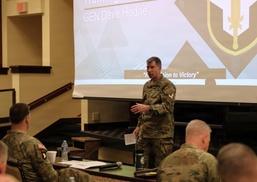
The commanding general of U.S. Army Transformation and Training Command, Gen. David M. Hodne spoke to Army Aviation leaders gathered for the Aviation Senior Leader Forum at Fort Rucker on Jan. 26.
The previous day, he toured the installation’s facilities and talked with Soldiers and leaders. The tour included a stop at the MV-75 prototype simulator, the Aviation Captain’s Career Course where he spoke with students about their current challenges and the direction the Army is headed, and an orientation flight in the UH-72 Lakota helicopter.
“It’s great to get back to the home of Army aviation. I’m always inspired at where we develop the world’s greatest aviators,” Hodne said.
Hodne, who assumed command of T2COM during its activation in October 2025, explained the last time the Army inactivated a four-star command was in the 1970s. He described the formation as “bold, historic and decisive,” adding that his organization is only 100 days into its existence. Hodne explained T2COM’s focus on force generation, force development and force design.
He described the Army as Army Service Component Command centric, and his job is to provide a supporting command.
“My job is to make sure that I deliver capability to those service components. Capabilities are not solely materiel. It’s people—through Army recruiting command, it’s trained and developed leaders that go through the various schoolhouses; and doctrine—programs of instruction that are revised in real time to keep pace with the changing character of war. It's an exciting time. From recruits to robots, transformation and training command is responsible for delivering capability to the operational force.”
Hodne explained the difference between the operational force—the part of the Army that must be ready to fight tonight if called upon; and the generating force--the part of the Army that builds the Army that fights.
“The first is the showroom floor; the second is the assembly line. Everyone wants to be on the showroom floor. That’s cultural habits of the Army. Everybody wants to be standing next to the Maserati and they want to describe what they are doing on the showroom floor (operational Army). The assembly line is an essential component of our Army’s readiness. There are some incredible professionals that are all members of the assembly line,” Hodne said.
Part of that generating force is the Aviation Center of Excellence that trains Army aviators and Air Traffic Controllers at Fort Rucker; Army Aviation maintainers at Joint Base Langley-Eustis, Va.; and Unmanned Aircraft Systems operator/maintainers at Fort Huachuca, Ariz. The Center prepares Army Aviation leaders and Soldiers to serve as part of the ground fight operating in the upper tier of the land domain.
Hodne said there will always be a need in the Army for manned and unmanned aviation capability in the air-ground littoral. “We’ve got to make sure we can operate both at the same time,” he said.
T2COM is also revamping how the Army looks at lessons learned as the Army Combined Arms Command works on a smart search, AI-enabled generative tool. This would enable Soldiers across the Army to ask questions, and it will cite the sources and provide feedback to them.
For force design, Hodne said the Army must consider its main potential adversaries and ask the question, “Is our Army purpose built? If not, do we have the stomach to do whatever it takes to make sure it is purpose built?”
Hodne also said his command supports the Portfolio Acquisition Executives (PAE), that are partnered Center of Excellence commanding generals and Program Executive Officers that directly report to Hodne. Maj. Gen. Clair A. Gill, AVCOE and Fort Rucker commanding general, serves as the PAE-Maneuver Air.
The bottom line for T2COM’s efforts is enabling the Army to win by redefining how the Army generates, develops, and designs its forces to ensure readiness at the speed of relevance.
“Changing today is insufficient; we’ve got to transform,” Hodne said.
Gill thanked Hodne for visiting Fort Rucker, adding that Hodne has been “moving” the Army in a short time frame.
“You all probably feel it,” Gill said. “We certainly know it here in the Aviation Center of Excellence. Our branch has been right in the mix of it.”
The Aviation Center of Excellence trains, educates and develops Aviation warfighters. The Center continuously drives change and transformation to maximize manned and unmanned Aviation's effect as a member of the combined arms team on current and future battlefields.