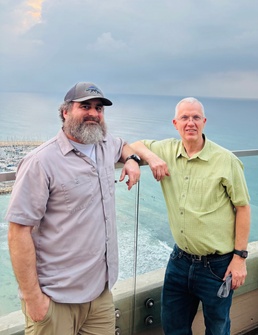
To an outsider, the leap from studying tree rings to military infrastructure planning might seem like a big one. But for Dr. Joshua Kincaid, a former professor at Winchester, Virginia’s Shenandoah University, who was looking for a change of pace, his academic background made him a strong candidate for an open community planning position with the U.S. Army Corps of Engineers (USACE), Middle East District.
Community planning involves predicting the needs of a community over time, considering population changes, infrastructure needs, weather, environmental issues, and a host of other factors. In the case of the Middle East District, those “communities” happen to be U.S. and allied nation military bases across the Middle East.
“My Ph.D. specialty areas were in ecological biogeography, human-environment interactions (human impacts on the environment), and yes, dendrochronology (tree-ring analysis). My focus areas included forest dynamics, tree rings as records of climate and hydrology, and stream morphology and hydrology,” said Kincaid.
He believes that an interdisciplinary background in environmental studies and geography laid a strong, holistic foundation for the analytical frameworks necessary for professional planning work.
"Our work centers on collaboration with stakeholders to support mission effectiveness, strategic growth, and functional compatibility across military infrastructure components," Kincaid said.
This involves focusing on the long-term development of military installations through a holistic framework that integrates environmental stewardship, facilities planning, land use, and regulatory considerations.
Community planning brings together multiple disciplines to ensure each aspect of a plan considers the other. This involves working with people from a variety of specialties, both inside and outside his organization, and that’s one aspect of the job Kincaid enjoys.
“Work in the Planning and Requirements Branch is a highly collaborative effort. The team, composed of individuals from diverse and interesting backgrounds, approaches projects collectively from the initial stakeholder meetings through final deliverables.”
And while operational security restricts him from sharing specific details, Kincaid stated he appreciates being able to see high-level strategies turned into concrete, actionable items that ensure the Middle East District’s U.S. military and allied partners can meet their mission requirements.
Kincaid's unique blend of academic expertise and practical, collaborative planning makes him a valuable asset to the U.S. Army Corps of Engineers, showcasing how a non-traditional path can have a significant impact on mission success.
“The variety of projects, the travel, and the people all make this an ideal job,” he said.
The Middle East District’s Planning and Requirements branch is a team of 19 planning specialists, Architecture and Engineering (A-E) contract managers, and supporting specialties who conduct planning assessments through full development of A-E design contracts for everything from small infrastructure improvements to a full-scale military installation build from scratch.