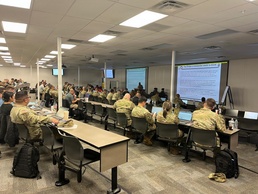
OGDEN, Utah — Army Reserve leaders from across the 807th Theater Medical Command gathered at the Western Regional Training Center in Ogden, Utah, Jan. 13–15, for a G8 Boot Camp designed to strengthen financial management, improve audit readiness, and ensure units can effectively train, equip, and deploy Soldiers.
Led by the 807th TMC G8, the boot camp focused on breaking down complex fiscal regulations and translating them into practical tools for commanders and staff at the unit, battalion, and brigade levels.
“A significant portion of the training is geared toward preparing our units, battalions, and brigade staff through financial and resource management training to help them train, equip, and deploy their units,” said Mr. Robert Ferguson, acting resource management officer for the 807th TMC. “We break down the vast and complex set of regulations to help our units navigate and apply the rules correctly to ensure we maintain audit readiness and mission success.”
Unlike the Active Component, Army Reserve units face unique challenges in maintaining proficiency across complex systems while balancing limited training time. According to Ferguson, that makes deliberate, targeted instruction critical.
“The training we provide is arguably more significant for the Army Reserve as compared to the Active Component due to the fundamental differences in structure, training opportunities, and primary roles,” Ferguson said. “The Army Reserve has a label of ‘part-time,’ and with that, knowledge of complex systems and regulations can fade. This training becomes the primary means to refresh and maintain the high level of proficiency required of command teams and staff.”
Throughout the course, instructors walked students through the fundamentals of financial management, including budget creation, identifying requirements, tracking funds, and managing resources. The training prepares the staff on how to apply improvement methodologies such as lean into managing Integrated Requirements Lists (IRLs) and submission of Mission Support Requests.
The goal is to enable leaders to immediately apply what they learn upon returning to their units.
“This comprehensive training prepares battalion and brigade staff on how to function effectively in staff roles such as resource manager or within S3 and S4 sections, ensuring missions are well supported and executed efficiently,” Ferguson said.
For many attendees, the boot camp provided a broader perspective on how funding decisions impact readiness beyond their own formations.
Mrs. Monica De Leon, supervisory staff administrator for the 341st Medical Battalion (Multi-Functional), said learning how IRLs connect missions and costs across the command changed how she views resource planning.
“The IRL gives you each unit’s missions, upcoming missions, and funding requirements,” De Leon said. “It gives you a broader sense of what type of funds are going to be used and how much it’s going to cost. We’re not the only ones that have training going on, and sometimes we get narrow-scoped, looking only at our battalion.”
Seeing requirements across multiple units highlighted the importance of accurate forecasting and documentation.
“It makes you understand that the funds have to be captured,” De Leon said.
The boot camp also addressed areas that many Soldiers find challenging, including contracting and Government Purchase Card procedures. De Leon said the training reinforced the importance of precision and accountability.
“Contracting is probably the hardest concept for me,” she said. “You really do have to treat every purchase case by case. Since this is something you’re liable for, you have to do it correctly.”
Ferguson emphasized that strong resource management directly affects readiness and risk mitigation across the command.
“The G8’s core mission is to manage the budgeting and execution of resources to enable our units to build and maintain a ready force,” he said. “This leads to improved funds control, maintaining audit readiness, successful current-year execution, and fully supporting brigades in accomplishing their training and missions.”
The course brought together Soldiers and civilians with a wide range of experience levels, creating opportunities for discussion and mentorship. De Leon noted that exposure to experienced personnel helped newer staff understand the depth of the G8 mission.
“There were people in the classroom with years of experience,” she said. “It was my first time and it helped put into perspective what questions to ask and what I still need to learn.”
According to Ferguson, the training is intended for a broad audience, not just financial specialists.
“Unit, battalion, and brigade command teams, along with battalion and brigade staff, benefit from the training hosted by the G8,” he said. “We help them understand what funding is and how to maximize it as a resource to enable mission success and access to a wide variety of training opportunities.”
He also addressed a common misconception about the G8’s role within commands.
“Some may think the G8 gets in the way or makes things restrictive,” Ferguson said. “We strive to work with and build cooperative relationships with commanders and staff to help them understand the flexibility they have and how to guide their own destiny without running afoul of complex laws and regulations that govern fiscal and fiduciary responsibility.”
For De Leon, the value of the boot camp extends beyond theory and into daily operations.
“In the next 90 days, I’ll be using the IRL and OMAR (Operation and Maintenance, Army Reserve),” she said. “Every month, we’re using different types of funds and lines of accounting, especially for travel. This helps make sense of how it all fits together.”
By strengthening financial literacy and collaboration across the formation, leaders say the G8 Boot Camp plays a critical role in ensuring the 807th TMC remains ready to support missions at home and abroad.