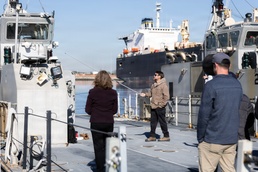
Blount Island Command supported joint autonomous testing of the Improved Navy Lighterage System in January, allowing the Navy and Marine Corps to evaluate emerging ship-to-shore logistics capabilities designed for contested and degraded environments.
The testing took place at Marine Corps Support Facility Blount Island in Florida, where INLS is sustained and postured for operational use, enabling evaluations using existing infrastructure and expertise already supporting the warfighter.
“This testing shows how we can apply autonomy to an existing platform and expand its usefulness without redesigning the entire system,” said Joseph Messenger, Naval Facilities Engineering and Expeditionary Warfare Center Software Support Activity (NAVFAC EXWC) work center supervisor.
“Autonomous littoral operations allow us to take Sailors and Marines out of harm’s way while still moving equipment ashore,” Messenger said. Responsible for developing the capability, he hosted a walkthrough Jan. 30 for military and civilian experts preparing to brief a platform review board.
Transitioning from automation to autonomy requires fusing sensor data into real-time navigation decisions without direct human control, allowing vessels to operate within defined parameters, avoid collisions and maintain cybersecurity in uncertain environments.
The autonomous capability development was funded by U.S. Transportation Command, while the dynamic positioning system that supports automated vessel control was funded by the NAVFAC EXWC.
By testing at Blount Island, the Navy maximized its use of existing resources, infrastructure and technical expertise. The effort included military personnel from Amphibious Construction Battalion One, enabling INLS operations, and Assault Craft Unit Two, which supplied utility boat operators.
Blount Island Command provided the watercraft required for the testing and access to open water along the facility’s 1,000-foot slipway. Conducting the evaluations at the system’s sustainment location allowed testing to proceed efficiently, using established operating areas without expanding the facility’s environmental footprint along the St. Johns River.
Messenger coordinated multiple Navy engineering organizations to design, integrate and commission autonomy on an INLS causeway ferry, advancing the capability’s readiness through pier-side and at-sea testing. He also developed a conceptual design to transition the system to a containerized, externally connected architecture, allowing greater flexibility for deployment across selected craft.
Originally fielded in the early 2000s, INLS is sustained by the NAVFAC EXWC and remains a versatile logistics platform applicable beyond traditional amphibious missions. Recent research, development, test and evaluation efforts have focused on extending its utility through modular upgrades, autonomy and interoperability with evolving expeditionary concepts.
The testing ensures Navy prepositioning equipment is actively managed across its lifecycle, keeping forward-positioned capabilities ready through deliberate testing that extends operational value and bridges current capability to future requirements.
This month’s testing at Blount Island demonstrated how Navy–Marine Corps integration, disciplined stewardship and a skilled workforce can mature emerging capabilities responsibly, accelerating watercraft innovation while preserving mission-essential infrastructure.