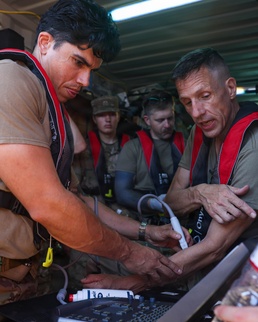
FORT SHAFTER, Hawaii — U.S. Soldiers assigned to the 8th Forward Resuscitative Surgical Detachment, 18th Theater Medical Command, conducted maritime casualty evacuation training aboard the Maneuver Support Vessel (Light) SSG Elroy F. Wells off the coast of Oahu, Hawaii, Jan. 23, 2026.
The training focused on maritime casualty evacuation (CASEVAC) operations conducted from non-medical platforms. The curriculum covered the full continuum of care, including small‑boat casualty reception, patient transfer, medical communications, patient management, surgical procedures, and extended sustainment operations.
“CASEVAC is essentially doing medical evacuation on a platform that is not a dedicated medical platform,” said Maj. Alexander Borges, emergency physician with the 8th Forward Resuscitative Surgical Detachment. “So in order to do that on this MSV, we brought over a container, which we retrofitted with an emergency department section and an operating room section. We also have a general‑purpose tent that is being fitted to use as an ICU.”
To build this capability, the team started with empty containers at their motor pool and worked collaboratively to design and construct a realistic treatment environment capable of supporting combat casualties at sea. During simulated casualty notifications, medical personnel rehearsed rapid preparation procedures to ensure readiness upon patient arrival.
“When we get the call that we’re going to be receiving patients, we immediately go into preparation to receive them,” Borges said. “That means hanging blood, preparing medications we anticipate needing, and having the right providers and the right medical team in the right positions.”
Logistics and the maritime environment presented unique challenges. Soldiers coordinated closely with the vessel’s crew and other Army units to move and set up equipment while adapting to operations aboard a moving ship.
“It was a multi‑team effort between us, the 25th Infantry Division, and the crew of the vessel to be successful. Working on a rocking boat was a new challenge,” Borges said.
Crew members adjusted the vessel’s operations to support medical procedures when conditions allowed. The training also included vessel‑to‑vessel casualty transfers, supported by an Army dive team that transported simulated casualties by small boat to the MSV.
“The whole goal of this is to ensure sustained damage‑control surgical capabilities as far forward as possible,” Borges said. “Our goal is to continue bringing troops home safely back to their families.”
The exercise reinforces the Army’s commitment to pushing lifesaving care as close as possible to the point of injury, even in maritime environments.