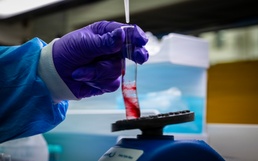
During an investigation, one of the most important factors that can determine the cause of an incident and ultimately lead to an acquittal or conviction, is the forensics. At the Armed Forces Medical Examiner System, one of its three divisions, is dedicated to exactly that, forensic science. AFMES’ Forensic Toxicology (FORTOX) division runs and maintains the Department of War’s only American Board of Forensic Toxicology International Organization for Standardization (ISO) accredited laboratories, adhering to the highest international laboratory standards.
This lab deals with a wide variety of cases, anything from aircraft incidents, workplace accidents and mishaps, DUIs and DWIs, to sexual assaults, homicides, suicides or unexplained deaths that happen on federal jurisdiction. Every sample for these investigations come through AFMES’ FORTOX division, where they will accession, test, and even provide expert testimony in criminal cases, when called upon.
Within AFMES’ FORTOX division, there are multiple sections performing different functions, all contributing to the same mission. The Human Performance & Postmortem Section consists of an accessioning team that receives all samples, an extraction team that prepares those samples for testing, and a screening and confirmatory screening team that identifies the presence of drugs or alcohol and their concentration. The last step is the laboratory certifying official, where toxicologists review all the data and provide a final report to the requesting customer.
“We are the only forensic toxicology laboratory in the DoW,” said Jessica Knittel, FORTOX, Chief of Laboratory Operations. “So, we get samples from all over the world.”
Samples are received through logistics and brought to the labs to be logged into the Laboratory Information Management System (LIMS). Each box contains at least one case, which is typical of something like a DUI, or up to thirty cases or more, with each case submitting from one sample all the way up to ten or more, depending on the scenario and circumstances. A technician assigns numbers to the cases and determines what type of testing needs to be conducted for each one.
Technicians aliquot these samples, usually blood or urine, create batches and assign them to a test, typically a drug or ethanol screen. If any results come back positive, they will then go to the confirmation section.
Probably the most unique feature of the accessions lab is that all the technicians are enlisted non-commissioned officers (NCOs), from the Army, Navy, and Air Force, forging a joint mission. They are all trained clinically to work in medical groups or medical commands, and understand how to process samples. However, unlike those assignments and because of this mission’s forensic nature, NCOs are desired to fill these spots at AFMES.
“We screen everyone to make sure they have that attention to detail, and can display that level of self-confidence and self-leadership that is needed,” said U.S. Air Force Capt. Thomas Burke, Chief of Strategic Laboratory Operations. “We do this because mistakes aren’t something that we can afford, because the impacts are just larger. When you have a mistake in forensics, the ripples can stretch years versus just a couple months.”
Because of this and the intricacy of the process, there are many safety nets throughout.
“For every single thing that a technician does, there is another person that goes back and reviews everything,” explained Burke. These are called second reviewers. “Once samples are chosen and accessioned, there is another person that reviews what they did and certifies that ‘yes, it's good to move on to the next stage.’”
This next stage includes screening or extraction. Screening samples generally requires very little in terms of extraction. The sample is placed into an analyzer which indicates the presence or absence of a substance.
If a substance is determined to be present, it can move through to this extraction process, which ensures that the sample is clean enough to go through what is called liquid chromatography tandem mass spectrometry and other more in-depth analysis, all of which have extremely low false negative rates. These analyzers determine concentrations of substances as well as how many substances are within a sample. If there are multiple drugs within a single sample, it may go through multiple extractions and confirmations, leading to longer turnaround times.
“Aircraft mishaps are probably our primary samples,” explained Knittel. “That could be anything from a bird strike, a pilot ejection, UAV malfunctions, or a groundcrew mishap. It ultimately depends on the command and their focus, but that’s a large portion of our casework.”
All aircraft incidents have a standard drug panel that tests for typical narcotics and an alcohol screen, which can be processed quickly.
“Due to the nature of pilot training, we try to push those as quickly as possible,” said Burke. “The majority of those screens are negative and pilots get placed on ‘do not fly’ status, we try to get those results out within a week so pilots can get back to their missions.”
Postmortem panels can take much longer. These panels are much more in-depth and can determine the presence of things like over-the-counter medication, overdoses, even medical interactions between multiple drugs. Everything from heart tissue, eye fluid, liver tissue, and anything else the medical examiner can collect during a postmortem autopsy, are gathered for investigative purposes. These postmortem panels test for over 300 different substances and can take anywhere from 30 to 90 days, depending on what is required.
Not only do the technicians have reviewers but the toxicologist that reviews the report will also review everything, from the moment the sample arrived at AFMES to the moment they receive the report, ensuring not a single step is missed. After that toxicologist is done reviewing and has certified its accuracy, it goes through a second toxicologist review, guaranteeing the report is completely accurate and has no possibilities for error.
Because of the concurrent missions under the AFMES roof, it has one of the largest contract lab staffs across the DoW. Aside from one officer, every toxicologist in the FORTOX division is a civilian. Due to the specialized nature of the job, it is necessary to have experts in this field. All other officers within the division are biochemists, and certify reports, provide consultations, and assist commanders in interpreting the reports.
“This level of continuity is great,” said Burke. “As expert witnesses, if a lawyer calls back two years from now and says, ‘we need you to testify for this case that happened two years ago,’ we are capable. And the process is so meticulous, we have a chain of custody that accounts for the sample(s), showing they weren’t interfered with, and there were no issues. That is so defense attorneys cannot poke holes in our process. Our goal is to make sure every single result stands up in court.”
Last year, the AFMES FORTOX division processed 6,236 cases, up from an average of 4,500 to 5,000 cases, as the force wide Drug Demand Reduction Program introduced the testing of psilocin. Everyone from the officers, enlisted, contractors, and civilian employees maintains a high level of excellence and integrity with their standards. Their efforts stand out among labs worldwide, leading multiple fronts within forensic sciences in their service to the federal government.