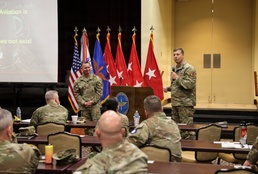
FORT RUCKER, Ala.--Army Aviation leaders from across the globe descended on Fort Rucker for the annual Aviation Senior Leader Forum Jan. 27-29.
Approximately 200 Aviation brigade commanders, brigade command sergeants major and senior warrant officers, and current and former Army and Army Aviation leaders from across all Army components received updates and provided feedback on initiatives supporting the warfighter and Army aviation transformation.
The theme of this year’s event was “Army Aviation: Transforming with a Vision.”
In his Aviation branch update, event host Maj. Gen. Clair A. Gill, Aviation Center of Excellence and Fort Rucker commanding general, reflected on the Chief of Staff of the Army’s visit to Fort Rucker a year ago, when he challenged the Center to develop a vision for the future.
“He challenged us on a number of things we were thinking about. He had already made up his mind on where we’re going with Army transformation,” Gill said. “He said … think about the current application of technology, the way you’re going to train warfighters, and I want you to come back to me with what that is going to look like.”
Gill reflected on a busy year in 2025, including the rollout of the Army Transformation Initiative, amidst force design updates. “A lot of goodness to that, but a bit of a shock to the system about how fast we were going to move some things. It’s had some effect on your formations,” Gill said.
“We cranked out the vision, and then the Secretary of War released his acquisition reform directive and called all the acquisition folks together.” Gill noted the Army is the first service to establish Portfolio Acquisition Executives. Gill will now take on new responsibilities as the Portfolio Acquisition Executive-Maneuver Air, in addition to his job as the Aviation branch chief and Fort Rucker senior commander.
The vision focuses on being able to “deploy, fight and win, provide land-focused air capability, conducting combined arms operations, leveraging technology both manned and unmanned by well-trained aviation Soldiers, underpinned by everything about that warfighter culture,” Gill said.
Gill’s branch updates were sorted into four main bins—formations; the environment—including the proliferation of Unmanned Aircraft Systems and aviation in Large Scale Combat Operations; future development—including the MV-75 tiltrotor aircraft; and people.
Gill clarified that while restructuring efforts will remove more than 6,500 aviation authorizations, the majority of those positions are currently vacant. The actual number of impacted personnel is approximately 100 commissioned officers, 200 warrant officers and 1,300 enlisted personnel.
Gill said the Center looks to revamp its flight school model to deliver a more proficient aviator in the future through a commercially owned and operated initial flight training program, followed by training in the Army advanced aircraft at Fort Rucker. He noted the current flight school model utilizes the UH-72 Lakota for initial training produces aviators who are “good systems managers but not good stick and rudder pilots.” The COCO model would potentially increase the amount of flying time the students get during Initial Entry Rotary Wing training, an opportunity to solo, and come at a significant cost savings for the Army.
Among the many ongoing transformation efforts, the branch plans to train 2,000 Soldiers in the new 15X military occupational specialty. “I think of them as combined arms maneuverists that are going to be out there advising commanders, helping formations, training them, building, planning, facilitating, integrating in the formations,” Gill said. “I’m very proud of this.”
Gill explained the need for transformation now.
“We have always been a decisive element of the combined arms fight for the Army,” Gill said. “In the Global War on Terror era, the one we grew up in, we never really had to justify our existence because if you asked any brigade commander in the Army what they could have more of, they didn’t ask for more fires, they didn’t ask for more squads, they wanted more air. Air was that asymmetric capability that gave them that ability to outmaneuver anywhere on any of the battlefields. I think Sergeant Major of the Army (Michael) Weimer said, ‘that was combat, that wasn’t war’.”
Gill said for the future fight Army aviation must be more adaptive to the battlefield.
“That means what worked for us isn’t necessarily going to work of the future. So our branch has to be ready to adapt whatever way that warfare allows. What we can’t do is wait. We’ve got to adapt, we’ve got to transform now.”
Gen. David M. Hodne, commanding general of U.S. Army Transformation and Training Command, explained T2COM’s focus on force generation, force development and force design, at about 100 days into the command’s existence.
He described the formation of the new command as “bold, historic and decisive,” and lauded the hard-earned reputations of the former Army Training and Doctrine Command and Army Futures Command.
The T2COM supports Army service components commands, from the generating force up through the operational force. “From recruits to robots, transformation and training command is responsible for delivering capability to the operational force,” Hodne said.
The forum’s three-day lineup of guest speaker sessions included updates from Lt. Gen. Michael C. McCurry, commanding general of Futures and Concepts Command; Maj. Gen. Lori L. Robinson, who commands Aviation and Missile Command; and Brig. Gen. Phillip J. Kiniery, Infantry School commandant at the Maneuver Center of Excellence.
Joining virtually to provide updates were the Hon. Michael A. Obadal, Under Secretary of the Army and former Army aviator; and Lt. Gen. Joel B. Vowell, deputy commanding general for U.S. Army Pacific.
Attendees also received updates from Human Resources Command.
The forum included a panel session with the Aviation branch leadership based at Fort Rucker: Gill led the updates on imperatives the branch is working; Command Sgt. Maj. Kirk R. Coley, Aviation branch command sergeant major, emphasized initiatives across the branch including continuous transformation in AIT and PME; and Chief Warrant Officer 5 Robert S. Slider, chief warrant officer of the Aviation branch, reiterated the important role the warrant officer will play in the future as the Army transforms.
Daily breakout working groups tackled problem sets and briefed their findings. Topics included solving airspace management in complex environments, leveraging Artificial Intelligence and machine learning to improve outcomes and conditions-based maintenance and sustainment related issues, with Coley noting that they were able to flesh out some items the branch has been talking about for years.
“Thanks to the working groups for helping us focus with a vision on some of the things we need to fix from a maintenance standpoint, and all the different topics we’ve had. I think it was a great session,” Coley said.
Slider added that as the Army continues to modernize, he wants the branch to continue to build upon what the groups accomplished during the forum.