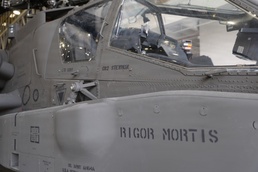
FORT RUCKER, Ala.— The legendary AH-64A Apache helicopter that fired the opening shots of the Gulf War has returned to the Home of Army Aviation, where it now stands as a permanent exhibit honoring generations of Army Aviation’s greats.
The aircraft, known as Rigor Mortis, was unveiled Jan. 28 during the Senior Leaders Forum at the U.S. Army Aviation Center of Excellence and remains on display at the U.S. Army Aviation Museum.
Rigor Mortis gained historical significance in January 1991 during Task Force Normandy, the Apache-led deep attack that destroyed Iraqi radar and air defense sites, creating a safe air corridor for coalition aircraft at the start of Operation Desert Storm. The mission marked the combat debut of the Apache and proved its effectiveness in large-scale warfare.
The helicopter was flown during that mission by then–Lt. Col. Richard “Dick” Cody, commander of Task Force Normandy, who later rose to become the Army’s 31st vice chief of staff.
“Yes, this is one of eight Apaches that flew the Task Force Normandy raid,” said Gen. (Ret.) Dick Cody. “I flew it with then-Chief Warrant Officer 2 Brian Stewmon, my front-seater, and now the aircraft sits in the museum for all to see and experience. But it’s really about the crew chiefs.”
Cody emphasized the care the aircraft received across decades of combat service.
“Back then, crew chiefs passed the logbook from one crew chief to the next, and they stayed with their aircraft,” he said. “The fact that this aircraft flew in the Gulf War on the first strike, then came back to the 101st and later deployed in the Global War on Terror is a testament to the crew chiefs who maintained it and kept that warhorse in the fight. That’s why you can see it here today. It’s only fitting that its home is at Fort Rucker.”
A unique aspect of Rigor Mortis’ legacy is its multigenerational connection to the Cody family. Both of Cody’s sons —Col. Tyler Cody and Col. Clint Cody— also flew the same aircraft during their own Army aviation careers.
Col. Tyler Cody, 16th Combat Aviation Brigade commander, reinforced much of what his father said in that “the aircraft is still the aircraft, it’s the people, the human aspect, not necessarily the evolution of the technology that has changed. The people evolved and were skilled enough to keep it lethal for all these years, and it’s still a key piece of the Army’s Aviation battlefield force today.
Tyler Cody said flying the same aircraft his father once commanded carried deep personal meaning.
“Being the new guy and having all that experience around me, people trained by my dad, and being able to fly inside the aircraft that protected my dad all those years was comforting,” he said. “Not only to me, but I’m sure my parents too. We are a family — the pilots, crew chiefs, maintainers, wrench-turners. It takes all of us bonded as a family unit to be successful. Seeing Rigor Mortis in the museum is cool, but it’s really the people that make it special.”
His brother, Clint Cody, now serves as chief of staff for the Army Aviation Center of Excellence at Fort Rucker. “I never thought I would see an aircraft that I flew in a museum while I was still serving,” Clint Cody said. “What an honor it is to have the Apache that my dad flew, the same one my brother and I had the opportunity to fly, on display here at the museum.”
The restoration of Rigor Mortis was a major undertaking led by Todd Stephens, an M1 Production Control supervisor, with support from museum staff, contractors, volunteers and soldiers from Fort Rucker.
“Working on any aircraft destined for display at the Army Aviation Museum is an honor I will always carry with pride,” Stephens said. “Having the opportunity to help restore such a significant piece of Army Aviation history is truly remarkable. Being part of the effort to bring Rigor Mortis back to ‘Mother Rucker’ is an experience I will treasure for the rest of my life.”
Museum board members also played a key role in the restoration effort. Mark Carl, a museum board member, said projects like Rigor Mortis carry lasting responsibility.
“Being involved in the restoration of Rigor Mortis carries both responsibility and meaning,” Carl said. “Projects like this ensure the story of Army Aviation is preserved with integrity and respect. It’s about honoring the men and women who flew, fixed and supported these aircraft and making sure their contributions are accurately represented for future generations.”
The project also included the expertise of U.S. Army Aviation Museum Curator Bryant Macfarlane and Fort Rucker Historian Billy Croslow, who emphasized the aircraft’s broader historical significance.
“The aircraft’s importance extends beyond a single mission,” Croslow said. “It represents the successful debut of the Apache in large-scale combat and symbolizes the evolution of the all-volunteer Army after the lessons of Vietnam. Its return to Fort Rucker, the Home of Army Aviation, serves as a tangible link to the past for new generations of aviators and the public.”
The restoration marked the culmination of a decade-long effort by retired museum directorBob Mitchell, who tracked the aircraft through multiple modifications to ensure it was preserved for its historical value rather than scrapped.
Now on public display, Rigor Mortis serves as both a historic artifact and a leadership lesson for future Army aviators — many of whom were born after 9/11 or have little memory of the Gulf War.
TheU.S. Army Aviation Museumis open to the public at no cost. Visitors must obtain a valid gate pass to access Fort Rucker.
For More information about the U.S. Army Aviation Museum visit: http://www.armyaviationmuseum.org