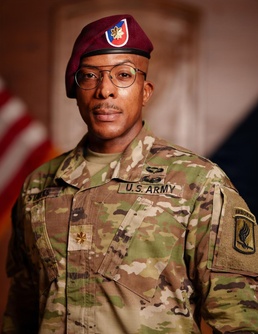
VICENZA, Italy -- Not many Army officers can say they’ve worked inside the White House and U.S. Congress. 173rd Airborne Brigade Maj. Laterrious “Tony” Starks can. Now he’s using that experience to help shape the next generation of public servants.
Starks, an Army officer recently selected as an Armed Forces ambassador for the United States Senate Youth Program, once served as a White House Social Aide Program manager. In that role, he worked behind the scenes at state dinners, diplomatic receptions and senior-level engagements, gaining a close-up view of how the executive branch operates at the highest levels.
Today, that firsthand knowledge helps him prepare high school student leaders for their own rare access to the nation’s top decision-makers.
“I was incredibly humbled and excited,” Starks said about his selection as one of only 17 military officers chosen across all service branches to mentor students in the program. “My first thought was about the responsibility that comes with representing the military to such a bright and motivated group of young leaders.”
The United States Senate Youth Program, or USSYP, is a highly competitive national program for high school juniors and seniors interested in public service. Each year, 104 students—two from each state, the District of Columbia and Department of Defense Education Activity schools—are selected for “Washington Week,” an intensive visit to the nation’s capital.
During the week, students meet with senior officials from all three branches of government, including senators, Cabinet members and a Supreme Court justice. Each participant also receives a $10,000 college scholarship.
“What makes it so significant is not just the access, but the inspiration,” Starks said. “For many of these students, it’s a life-changing experience that strengthens their commitment to public service.”
As a military mentor, Starks is responsible for a small group of students throughout the week. His job goes far beyond logistics.
“My role is a blend of guide, counselor and role model,” Starks said. “We travel together to briefings and meetings, but some of the most important conversations happen on the bus, over meals, or walking between events. That’s where we talk about leadership, integrity, career paths and service.”
Preparation is a major part of his work. Starks helps students research the officials they’ll meet, understand current policy issues and learn the etiquette expected in formal settings. He also coaches them on asking thoughtful questions and speaking with confidence.
“It’s not about telling them what to ask,” he said. “It’s about giving them the tools to think critically and engage in meaningful dialogue.”
This is not Starks’ first time serving as a mentor; he previously participated in 2019 and 2021. He says the students are what keep him coming back.
“Being around such a diverse, driven group of young people restores your faith in the future,” he said. “I’ve learned that sharing my own journey, including challenges and lessons about resilience, often resonates more than any formal briefing.”
One memory still stands out. Starks recalled a student who was bright but hesitant to speak during early sessions.
“During a meeting with a Supreme Court justice, that student raised their hand and asked an incredibly insightful question,” he said. “You could see the confidence click into place.”
If there’s one lesson he hopes students carry with them, it’s about purpose.
“Public service is a noble calling, and it comes in many forms,” Starks said. “It’s not about titles or recognition. It’s about the positive impact you make. If they hold onto that, they’ll go on to do incredible things.”