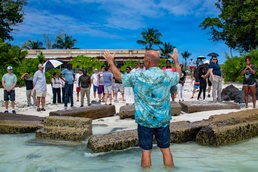
DIEGO GARCIA, British Indian Ocean Territory (Jan. 30, 2026) – The Navy emphasizes holistic readiness across the force, making spiritual readiness and resilience essential components of overall warfighting effectiveness.
While often associated with religious practice, spiritual readiness applies to all service members, regardless of faith or personal belief system. The Navy defines spiritual readiness as the strength of spirit that enables the warfighters to accomplish the mission with honor. Spiritual Readiness is not only about the will to fight, but the ability to overcome adversity in the moment of combat or crisis.
Chaplains and religious program specialists play a key role in providing care, facilitating access to diverse faith practices and supporting all authorized personnel, religious or non-religious alike.
“Spiritual readiness is connecting with the transcendent, something greater than oneself through four primary components: connection, community, sacrifice and meaning,” said Lt. Cmdr. Timothy DeLaughter, a chaplain onboard Navy Support Facility Diego Garcia. The chaplain expounded on the primary components. Connection refers to a relationship with the divine or with what an individual considers sacred or ultimate truth. Community emphasizes participation in a group with shared beliefs and values, whether religious or value-based. Sacrifice reflects a willingness to give up personal comfort or desire for the greater good. Meaning centers on the pursuit of purpose, service and values beyond self-interest.
Together, these elements form the foundation for spiritual resilience, the ability to endure, adapt and recover when confronted with stress, hardship or uncertainty.
Religious Program Specialist 1st Class Casey Niedorf, assigned to NSF Diego Garcia, explained warfighters who exhibit spiritual resilience and readiness accept that hardship is a part of life and service, but ultimately are convinced they will overcome because of a belief in something bigger than themselves. “It’s a mindset of perseverance,” said Niedorf. “You understand you’ll be challenged and uncomfortable, but you can see the other side of it. Those challenges shape who you are and build resilience.”
Spiritually ready Sailors recognize that they are not the only ones in the fight. Instead, they understand their role as part of something larger than themselves, like supporting fellow service members, completing the mission, and defending national interests. This mindset fosters patience, selflessness and perseverance, qualities that are critical to sustaining morale and cohesion in demanding conditions.
Spiritual readiness also plays a direct role in warfighting effectiveness. Conflict is fought not only on physical, but mental fronts. A foe who can undermine their adversary’s sense of purpose and resolve can weaken their ability to fight and endure.
Questioning one’s beliefs or suddenly appealing to a higher power is natural when faced with the stresses of conflict, but it may not be effective if not exercised before crisis occurs. "If we are practicing 'foxhole faith', it's too late," said RP1 Niedorf. By cultivating spiritual readiness before crisis occurs, service members strengthen their ability to withstand internal and external pressures. Spiritually resilient Sailors are better equipped to manage stress, recover from adversity and maintain focus on mission objectives rather than personal discomfort.
The benefits extend beyond the individual Sailor. Families, units and commands all gain strength when service members are anchored to a sense of purpose that transcends circumstance. In turn, this contributes to readiness across the force.
As the Navy continues to adapt to complex global challenges, spiritual readiness remains a vital element of comprehensive preparedness. By reinforcing purpose, resilience and commitment, the Navy ensures that its Sailors are prepared not only to fight, but to endure and prevail.