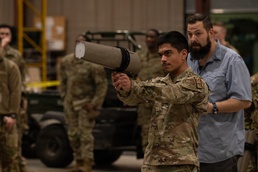
JOINT BASE ELMENDORF-RICHARDSON, Alaska — In recent years, drones have become an ever-present fixture in the world. Large airplane-like models are used overseas in military operations while smaller more compact versions have carved out a place in the lives of hobbyists and social media influencers. These relatively affordable and readily available devices enable regular people to capture scenery from a perspective once reserved for professionals with helicopters.
The mountains, fjords, and rainforests of Alaska are emblematic of the landscapes people want to record, and in much of the state, drone use poses no threat. On Joint Base Elmendorf-Richardson though, flying even the smallest drones can be dangerous.
“We primarily deal with what we call ‘clueless and careless’ operators,” said U.S. Air Force Staff Sgt. Taylor Davis, 673d Security Forces Squadron counter-small unmanned aerial systems (C-sUAS) noncommissioned officer in charge. “Imagine a recreational drone operator launches their platform hundreds of feet into the air near the flightline. Now it’s potentially in the path of one of our aircraft. The damage a drone can do to an F-22 [Raptor] or C-17 [Globemaster III] is significant and unpredictable."
Identifying, intercepting and investigating all sUAS, or drones, in JBER airspace is a vital part of installation defense but it’s not a job that security forces can accomplish on their own.
“We can’t respond to a drone if we don’t know it’s there,” explained Davis. “We rely greatly on what we call ‘human sensors’ to help track these systems. Everyone on base shares responsibility for identifying and reporting drone use.”
While many of the cases investigated by security forces reveal accidental violations, there are more serious scenarios to consider.
Adversaries with ill intent can use camera-equipped drones to perform reconnaissance and intelligence-gathering operations over sensitive areas of the installation. A more extreme scenario might mirror what has been seen in the ongoing conflict between Russia and Ukraine where drones have been loaded with explosives and turned into weapons. In order to determine the level of threat, the incident must be investigated.
“It’s impossible to tell the motivations of a drone operator from initial observations," said Davis. “We have to locate the operator and then make that determination. To help us do that, we encourage everyone to report all drone sightings.”
When it comes to reporting the two most important factors are location and timing. Being as specific as possible about the location of the sighting is paramount. Communicating the sighting as soon as possible helps the C-sUAS response team begin their search before the drone can disappear.
“With location, the more specific the better,” added Davis. “If you’ve got an address, or a major intersection or landmark that’s great. If it’s a more remote area of the base, we can use your phone’s GPS coordinates.”
The primary concern for the counter-sUAS team are the commercially available drones which come in a variety of shapes and sizes. Attributes to look out for when reporting a drone sighting involve the movement, form and sound of the device. Some have a set of four helicopter-style rotors and can hover in place; some resemble traditional fixed-wing airplanes; others are hybrid designs that combine elements of both. Depending on the design, the sound they produce can vary as well. Models with gasoline engines can be very loud; electric models produce a distinctive high-pitched whirring sound.
“As with any crime, the more details we can get, the easier it will be to investigate,” said Davis. “The design of the device, the color, the engine type, the direction of travel and if there’s a payload are all really helpful details. If you see the operator, try to provide a description of that person or their vehicle.”
Drone use over JBER airspace is not only dangerous, it’s a violation of federal law. Sightings should be reported immediately to the JBER Law Enforcement Desk. If you see a drone, call 907-552-8550. Visit the JBER Connect app homepage to access a guide which includes vocabulary and pictures to help you gather and communicate the most relevant details to the 673d SFS.