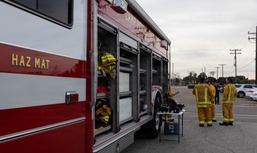
CAMP PENDLETON, Calif. - Semper Durus is an annual interagency training exercise designed to strengthen regional defense, test anti-terrorism measures, and ensure personnel safety against evolving threats across Marine Corps Base Camp Pendleton. Before, during, and after Semper Durus, agencies aboard the installation maintain readiness and response effectiveness through targeted training exercises focused on specific areas.
With the focus on response effectiveness, partnering agencies across the installation participated in Command Post Exercise II at MCB Camp Pendleton, California, Jan. 28, 2026. CPX II intended to combine the efforts of various agencies across Marine Corps Installations West to exercise staff actions in response to a simulated contamination of the installation’s food supply. This included verifying the safety and security of food sources and their delivery, identifying the impact of food delivery interruptions, determining required response actions to re-establish safe food distribution, and exercising the Camp Pendleton Fire Department’s hazardous materials response procedures.
“The goal of today’s training is to highlight the capabilities of this HAZMAT team,” stated Tom Kircher, the mission assurance director and CBRNE protection officer with the mission assurance branch on MCB Camp Pendleton. “They are the only [Department of War] HAZMAT team in the state of California that is certified as a California state Type I team.”
The exercise highlighted the hazardous materials team’s capabilities and overall proficiency, while also including overall interagency cooperation with agencies aboard the installation, such as MCIWEST Mission Assurance, Marine Corps Community Services, the Defense Commissary Agency, U.S. Foods, Assistant Chief of Staff (AC/S) G-4, the Army Food Defense Team, MCB Camp Pendleton Fire Department, NCIS and the Criminal Investigation Division.
“CID notified us about the incident that is taking place, and because it is a higher-level incident, we, as the federal agency on base, are responding accordingly. We take interviews and figure out what is going on and then, if needed, make contact with outside law enforcement partners to try and best tackle the situation,” stated Jordan Ruth, a special agent with NCIS. “[CPX II] gives us a new perspective on base-wide involvement with significant incidents. It gives us a better training outlet to be prepared for incidents when they happen.”
Initiating through a standard food delivery and inspection, the participating agencies were tasked with identifying contaminated product, contacting the respective HAZMAT support, and conducting and resolving a formal investigation surrounding the identified hazardous material.
“Our role as the fire department is to assess, isolate, and deny entry, and then mitigate the hazard,” stated Robert Washburn, a division chief with the MCB Camp Pendleton Fire Department. “We’ll arrive, conduct an initial assessment, gather information, and based on that, we’ll develop a plan within our protocols and procedures.”
Following dispatch, members of the MCB Camp Pendleton Fire Department arrived on the scene. They followed hazardous materials response procedures proficiently, focusing on rapid isolation, scene control, and specialized mitigation of chemical, biological, radiological, and nuclear (CBRN) threats. Using MX908 devices, the responders quickly and safely identified and removed the hazardous substance.
“As a technical rescue firefighter, I make recommendations for PPE, identify the sample, the properties of the sample, decontamination recommendations, and just make sure we know what the hazard is and everything that is involved with that product,” stated John Negrete, a GS7 EMT and firefighter with MCB Camp Pendleton Fire Department.
By fostering a controlled training environment and exposure through exercises such as CPX II, all participating agencies can refine vital skills and knowledge, enhance members' confidence and capabilities, and strengthen interagency collaboration.
“We’re here to make sure that if anyone goes down, we provide life safety measures and provide support for them to mitigate any risks,” shared Cory Lofgren, a firefighter and paramedic with the MCB Camp Pendleton Fire Department.
CPX II is one of many training exercises conducted across the installation to ensure continuous precision and efficiency, upholding mission success to the highest standard against all threats on and off the installation. (U.S. Marine Corps story by Cpl. Jacqueline Akamelu)
-30 -