MONTEREY, Calif. – As the U.S. Department of the Navy continues to operationalize artificial intelligence (AI) across the Navy and Marine Corps, high-profile systems such as unmanned platforms or large-scale information tools grab most of the headlines. But the power of AI extends well beyond these examples, supporting data analysis for complex problem solving, process automation, and decision support tools at every level, among many others.
The U.S. Marine Corps is charging forward with an implementation strategy to leverage AI across the force. A key component of this effort is the U.S. Marine Corps Naval Postgraduate School (NPS) AI Fellowship, a new program that enables Marines to apply the capabilities of AI directly to operational challenges, translating emerging technologies into practical, data-driven solutions for the fleet.
“When the fellowship opportunity presented itself, I realized that this is where AI could be appropriately inserted. Not to do our jobs for us, but to streamline our existing process and free our operators to work on more complex problems,” said U.S. Marine Corps Capt. Stephen Steckler, a member of the inaugural cohort of AI fellows and an NPS graduate in computer science.
Developed in alignment with existing AI strategy and the 39th Commandant’s Planning Guidance, the USMC–NPS AI Fellowship program accelerates applied AI research while simultaneously developing the Corps’ AI workforce.
Launched in August 2025, fellowship program participants spent five months dividing their time between applied research and field experimentation on a use case each fellow has identified. The AI fellows received targeted AI instruction and mentorship from NPS faculty and industry experts to assist with hands-on research.
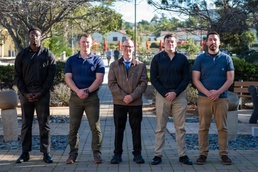
Fast forward to early 2026, and the inaugural cohort of USMC-NPS AI fellows returned to the campus to present their findings to Marine Corps leaders and a cross-section of NPS professors, faculty, students and advisors.
Dr. Christopher Paul, U.S. Marine Corps Chair for Information at NPS, is program lead for this first pilot of the AI fellowship, which he modeled after the U.S. Air Force Phantom program at MIT. The program is structured to integrate operational insight with technical expertise, Paul says, leveraging Marines who are familiar with contemporary fleet challenges and understand the potential of AI.
The use cases represented in this inaugural cohort demonstrate the far-reaching potential of AI, Paul says, and how it can be applied across the force by empowering people and their drive to innovate.
“One of our fellows, Cpl. Joe Sadler down at Camp Pendleton, is in a battalion maintenance facility. He’s looking to build a tool that's large language model-based that has an agentic shell that helps with the paperwork surrounding maintenance activities,” Paul explained. With considerable time and effort spent outside of the actual maintenance, Sadler’s idea has the potential to save significant time and effort, he says.
Steckler’s project is another example of using AI to help Marines do their jobs better and faster, Paul says. “He’s at the Marine Corps Operational Test and Evaluation Activity (MCOTEA) where they get all kinds of new gear and prototype gear, and they have to perform different red teaming and penetration testing of the circuits and the onboard computer apparatus in that gear,” Paul explains.
Steckler’s project explored the use of edge-deployed large language models to automate and streamline Marine Corps cybersecurity operational testing. Developed for MCOTEA, the system is designed to operate in classified, air-gapped environments while integrating existing commercial security tools into a single, natural-language interface, reducing both analyst workload and training demands. With an overall rate of accuracy at 93.3 percent, the project shows strong potential to reduce personnel requirements and testing timelines, with clear pathways for further development and operational adoption.
In this testing, too much time is spent on the application of known vulnerabilities and exploits, Paul says. “The vision is to build an AI tool that can automate a bunch of that process,” he notes, leaving more time to “think of creative ways to attack or possibly penetrate that gear, so that those vulnerabilities can be patched, closed or avoided before the gear is ever fielded.”
While the issues the fellows set out to address were complex, the goal of the fellowship is just as much about developing the Marine Corps’ AI workforce as it is about the final product. And in just five short months, Steckler says, there were a handful of critical lessons learned that he was eager to share with the next cohort of USMC-NPS AI Fellows, who were also on hand for the program review on campus.
“Scope your problem appropriately and pursue your rate limiting factor aggressively,” he said. “Whatever it is that you do not have up front and will take time to get, pursue immediately. With the professors and connections that NPS has, they can move mountains to get you what you need.”
While fellows performed the initial research sprint, programs like the Marine Corps Software Factory (MCSWF) provide a parallel pathway for operationalizing this work beyond the academic environment. With fellows focused on research-driven prototyping rooted in operational challenges, MCSWF works to translate these concepts into production-ready digital tools, reinforcing a broader ecosystem where Marines can move AI solutions from classroom to command.
Together, these efforts create a continuum that links education, experimentation and deployment, ensuring innovation does not stall at the prototype stage. Guiding these efforts is U.S. Marine Corps Col. Pedro Ortiz, Ph.D., MCSWF Liaison Officer for AI and Emerging Technology, on hand to hear the fellows’ presentations. Ortiz is a graduate of the [USMC Ph.D. technical program at NPS](https://www.marines.mil/News/Messages/Messages-Display/Article/4047808/fy26-marine-corps-doctor-of-philosophy-programs-phdp-selection-board-announceme/), designed to build a cadre of highly technical Marine Corps officers to identify technological breakthroughs for warfighting applications and support senior leaders in strategy and long-range concept and capability development.
“The projects presented today are a small and important sample of how Marines can implement AI solutions at their level,” said Ortiz. “I can envision in the future that this program could produce prototypes that the Marine Corps Software Factory could then transform into production-level software for use across the Marine Corps.”
Central to the plan is the principle that artificial intelligence must augment, not replace, Marines. As AI adoption escalates, balancing speed and risk emerge as a recurring theme. Marine Corps leaders acknowledge the rapid pace of AI development and the corresponding need for agility, while emphasizing that governance structures must remain robust.
“I am very proud of the breadth this program has become. We have such a dynamic range of participants — from government service employees to officers and even a corporal,” said Paul. “This program has the workings of great minds at every level of leadership.”
As the second cohort of USMC-AI Fellows gets underway, the Marine Corps is looking ahead, exploring the establishment of a Center for Digital Transformation to serve as a hub for AI knowledge products, prototyping and collaboration with academia and industry. Partnerships with institutions like NPS, and federally funded research and development centers, are expected to play a central role in this effort.
Naval Postgraduate School (NPS) is located in Monterey, California, provides defense-focused graduate education, including classified studies and interdisciplinary research, to advance the operational effectiveness, technological leadership, and warfighting advantage of the naval service. Established in 1909, NPS offers master’s and doctorate programs to Department of War military and civilians, along with international partners, to deliver transformative solutions and innovative leaders through advanced education and research.