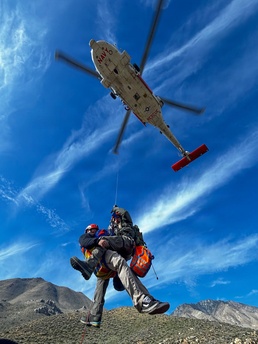
CHINA LAKE, Calif. — A search and rescue team assigned to Air Test and Evaluation Squadron (VX) 31 at Naval Air Weapons Station China Lake executed a rapid medical evacuation Dec. 3 following the ejection of an F-16 pilot approximately 15 miles east of China Lake.
Hospital Corpsman 1st Class NAC/FMF Brian Romero, a Navy Medicine Sailor and search and rescue (SAR) medical technician (SMT) assigned to a Navy Medicine Readiness and Training Unit China Lake, was part of the VX-31 SAR crew—nicknamed the “Dust Devils”—that launched within 30 minutes of notification to respond to the emergency. The Rescue 463 crew also included Chief Hospital Corpsman Albert Tran, a SAR medical technician and VX-31 SAR shop leading chief petty officer; Lt. George Smith, pilot; and Mr. Matthew McDermott, pilot.
“Within 30 minutes of notification, we took off from China Lake and headed toward the scene,” Romero said. “We got on station in about six minutes and hovered overhead to assess the scene.”
VX-31 SAR, operating under the call sign Rescue 463, conducts helicopter rescue operations in challenging terrain and integrates pilots, aircrewmen and SMTs to provide rapid response and medical support during emergencies.
Upon arrival, local emergency medical services and fire units were already on site and providing initial care. After conducting an aerial assessment, Rescue 463 landed approximately 75 yards from the EMS team to safely assume patient care.
Romero said the decision-making process was driven by the nature of the incident and the potential severity of injuries associated with a high-speed aircraft ejection.
“As SAR medical technicians, we are trained to recognize serious causes of injuries,” Romero said. “In this specific case, an aviator can experience extreme forces far beyond what the human body is built to tolerate. With this in mind, we moved with a sense of urgency.”
After evaluating the patient, the team determined the pilot required transport to University Medical Center Las Vegas, a Level I trauma center, to ensure the highest level of care following a serious mechanism of injury.
“The patient remained stable during transport to Las Vegas,” Romero said. “During that time, we continued to provide medical treatment and make the patient as comfortable as possible.”
Romero credited the team’s rapid launch to thorough pre-flight preparation and collective crew coordination.
“If it weren’t for the crew flying the morning before and us all working collectively to safely preflight the aircraft, we wouldn’t have managed to achieve the response time we did,” he said.
From the air, the SAR crew focused on scene safety and coordination with ground responders before committing to a landing.
“The biggest factors we consider are the condition of the patient and the safety of the scene,” Romero said. “Everyone communicates using crew resource management so we can safely execute the mission.”
Once airborne with the patient, the SAR medical team continued care during the flight, navigating challenges unique to the helicopter environment, including cold temperatures, vibration and limited space.
“All of those factors play a role,” Romero said. “It was cold flying over the mountains to get to Las Vegas, and vibration always affects care—especially with musculoskeletal injuries—so we did our best to protect the patient and splint injuries appropriately.”
Upon arrival in Las Vegas, the SAR crew coordinated a seamless transfer of care, escorting the patient from the helicopter to the emergency department.
“We were met by an EMS crew, and the SAR medical technicians rode with the patient in the ambulance to the medical facility,” Romero said. “The trauma team was prepared and ready for turnover when we arrived.”
Romero emphasized the importance of interagency cooperation in the mission’s success, citing the efforts of VX-31 SAR, University Medical Center Las Vegas, San Bernardino Fire and the U.S. Air Force Thunderbirds.
“It was awesome to see six Thunderbirds and one C-130 overhead while they maintained command of the scene until it was turned over to us,” Romero said. “That teamwork is what made everything go smoothly.”
VX-31 SAR teams routinely train for aviation mishap and rescue scenarios, maintaining readiness to conduct hoist operations and provide rapid response in mountainous and remote environments.
For Navy Medicine personnel like Romero, serving as an SMT in a SAR role extends Navy Medicine’s mission beyond the walls of a medical treatment facility, delivering critical care at the point of injury and supporting the safe transfer of patients to definitive care.
“Our primary mission is supporting aviators,” Romero said. “Getting the patient to the appropriate level of care without interruption is what matters most.”
By integrating advanced prehospital medical care with coordinated air and ground rescue operations, Navy Medicine Sailors embedded within SAR teams help ensure injured service members receive timely, continuous care from the moment of injury through arrival at a trauma center.