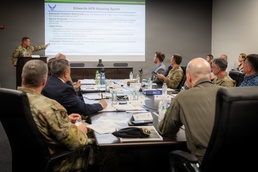
As a first step toward solving the critical housing shortage at Edwards AFB, the 412th Civil Engineer Group hosted a “Housing Sprint” workshop with representatives from the Office of the Assistant Secretary of the Air Force, Installation and Environment, Air Force Installation and Mission Support Center, Air Force Civil Engineer Center and Mayroad private housing, Jan. 12-15.
The workshop included first-hand accounts of Airmen who have faced nine- to twelve-month waitlists for on-base housing. The delay brings high costs for temporary lodging and the difficult dilemma of whether to continue waiting, or buy or rent in either unsafe or more desirable areas far from the base. Leaders warn these conditions directly affect quality of life, recruitment, retention and ultimately, mission success.
Two-fold mission growth during the last three years has fueled the need for a larger workforce, driving an increased focus on the housing shortage. The test portfolio at Edwards is expected to double again as major aerospace defense programs reach the developmental test phase.
To support these missions, Edwards leadership projects an increase of more than 800 civilian employees and more than 300 active-duty Airmen by 2028. Current housing capacity, however, falls well short of demand.
As of 2025, the base requires an additional 119 family homes and 307 dormitory rooms for military members alone.. By 2028, military housing needs are expected to rise to 140 homes and 736 dorm rooms. The need for both military and civilian employee housing has far outpaced growth in available units on base and throughout the Antelope Valley.
A lack of residential development near the base is both a blessing and a curse according to Col. Brad Bucholz, 412th Civil Engineer Group commander.
“The remoteness of Edwards has allowed us to sharpen American airpower through test,” Bucholz said. “But that same remoteness strains our ability to hire and retain the highly-skilled workforce we require.”
A tight local market, long commutes, the growth of major aerospace manufacturers and other industrial growth near the base have combined to create a critical housing shortage.
Compounding the problem, many lower-cost housing areas closer to base have been cited in media and government reporting as having elevated crime rates as high as twice the national average. This further limits safe, affordable options for lower-compensated workers, according to Bucholz.
Long-Term Decline in On-Base Housing
The housing shortage for military members is rooted in decades of reductions of on-base units. Between 1994 and 2011, the number of on-base family housing units dropped from 1,989 to 741 as aging homes were demolished and not replaced. Similarly, dormitory capacity declined from 758 rooms in 2001 to just 365 rooms by 2025.
Searching for Solutions
Solutions discussed at the workshop included construction of tiny homes - approximately 100-400 sq. ft., and more RV spaces at FamCamp and at Branch Park and containerized housing units for unaccompanied Airmen. A recent innovative solution involves establishment of enhanced used lease parcels for homes near base boundaries. These parcels would be leased to private developers to build, maintain and rent housing units to base members.
“The proposals briefed all require more work,” said Hugo Via, 412th CEG installation management division chief. “Participants need to further develop the options and work together to resolve hurdles.”
The Housing Sprint is only the first step in tackling a problem that, if left unresolved, could hinder Team Edwards and the Air Force’s ability to deliver victory…forged by test.