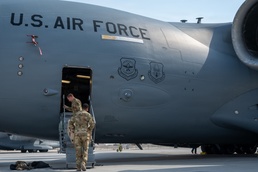
U.S. CENTRAL COMMAND AREA OF RESPONSIBILITY -- When senior leaders travel within the U.S. Central Command area of responsibility, it is important that they and their teams are able to maintain communication with personnel on the ground while in the air.
U.S. Airmen assigned to the 379th Expeditionary Communications Squadron Viper Team meet that need by setting up and maintaining in-flight secure and non-classified network access aboard C-17 Globemaster III and C-130 Hercules aircraft. The team is comprised of six Airmen who are on-call 24/7 and able to support up to two missions at a time.
Traditionally, the six slots are filled by active-duty Airmen on year-long special duty assignments. But when an unexpected vacancy occurred, 379th ECS leadership, rather than scrambling to source someone from thousands of miles away, worked with U.S. Air Forces Central Command’s A6 directorate to find a replacement among the communications professionals in the unit.
“We started looking internally to figure out who had the skills, weapons qualifications and outside-the-wire training,” said Senior Master Sgt. Raymond Shaw, 379th ECS senior enlisted leader. “Tech. Sgt. Jared Wells met the requirements, and he also had previous experience that tied in well to the skills needed to execute the viper mission.”
Wells, a Reservist deployed from the 302nd Communications Flight at Peterson Space Force Base, Colorado, was up for the opportunity his 379th ECS leadership provided him.
While he possessed the technical skills necessary to integrate into the Viper Team, there were other requirements and training Wells had to complete before he could qualify for a spot.
The requirements were primarily aircrew related. Wells needed a flight physical and aircrew-related training such as altitude chamber and Survival, Evasion, Resistance, Escape training, but he would have to go back stateside to complete them.
As for learning the Viper Team mission, Wells’s Air Force Reserve experience as an infrastructure technician set him up for success. At home, he supports the 302nd Airlift Wing by managing IT network infrastructure, including the configuration and maintenance of routers and switches. Wells also manages three tactical flyaway kits that belong to the unit, on which he is responsible for operating system upgrades, writing standard operating procedures and training his fellow 302nd CF members on how to employ the kits.
He also had the opportunity, prior to joining the 302nd CF, to support a mission very similar to what the Viper Team accomplishes.
“At my previous unit I was tied to the (Joint Communications Support Element) out of MacDill Air Force Base,” said Wells. “We did executive communications almost exactly like what the Viper Team does, for the (U.S. Transportation Command) commander at the time Gen. Lyons.”
He said the only real learning curve was becoming familiarized with the kit the team uses.
“It’s very ‘plug-and-play,’ however you need to know how it all is designed in case something breaks,” said Wells. “We actually had one kit where one of the cables vibrated loose inside the C-130, so we had to troubleshoot and find it to reestablish connectivity.”
While Reservists have augmented Viper Team missions as mission essential personnel, at eight missions, Wells became the first mission-qualified Reservist Viper Team member.
“It’s been fun,” said Wells of his experience on the team so far. “It’s been interesting being able to support these high-level leaders. I’ve done a few missions for Adm. [Brad] Cooper, the CENTCOM commander, and I was even able to speak with him. It’s great to get to connect with people at that level.”
Shaw said Wells embodies the Air Force Reserve Command’s Citizen Airman concept and that he is proud of his willingness and ability to step up and integrate seamlessly into the Viper Team.
When they are not in the air supporting leaders such as Cooper or U.S. Air Forces Central Commander Lt. Gen. Derek France, Wells said the team conducts routine preventative maintenance inspections to make certain the equipment is fully functional and ready at a moment’s notice.
The team also performs tail tests where they set up their kits on newly arrived C-17s and C-130s to determine whether the aircraft can support communications required for senior leader transport. Preparation and readiness are key to the Viper Team’s mission of 24/7 availability.