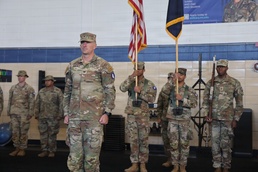
The ceremony was presided over by Col. Keith W. Benedict and Cmd. Sgt. Maj. Pedro Chavez, the command team for the ASCG-S. During the ceremony – coinciding with the furling of the colors and near-term departure of two organic battalions and one National Guard battalion from 54th SFAB. Col. Benedict reflected on 1st SFAB’s legacy and how it’s accomplishments and achievements will have long-lasting effects on the U.S. Army and our regional partners. Those bound for Panama then donned their jungle bonnie headgear, and all donned the U.S. Army South’s 6th Army patch.
1st Security Force Assistance Brigade was activated in October 2017 to fill the growing requirement for Advisors for Afghan security forces, alleviating the existing practice of pulling leaders from their formations to help Afghan units. 1st SFAB conducted one deployment to southwest Asia, where Cmd. Sgt. Maj. Timothy Bolyard, the senior enlisted advisor of 3rd Squadron, 1st SFAB made the ultimate sacrifice. After the Afghanistan tour, 1st SFAB became regionally aligned to the Southern Command area of operations, where they conducted security force assistance with Colombia, Argentina, Panama, and Honduras, among other partners.
The Army Security Cooperation Group – South is a unique unit within the Army, that falls under the newly-established United States Western Hemisphere Command (USAWHC), leading efforts to deepen and widen interoperability with Panamanian partners on strategic terrain and in the 2025 National Security Strategy’s priority region. “Our Soldiers are excited to build upon their experience working in Panama to establish a digitized training environment and work with our partners,” states Col Benedict, “to test and evaluate our warfighting capabilities in one of the most challenging jungle environs in the world.”
Under the new force restructure, ASCG-S has assumed responsibility for JSCG-P, which is working with the government of Panama to increase cooperation efforts between the U.S. Military and Panamanian security forces. JSCG-P is also crucial to the staging and reception of all U.S. military personnel coming to Panama to learn from partners and to test their mettle. “We are actively seeking jungle expertise and look forward to units across the joint force and the international community joining us this summer for Panamax 2026,” CSM Chavez states, “I assure you, this environment isn’t for the timid or entitled.”
JSCG-P is working with Panamanian partners to re-invigorate a combined JOTC at Aeronaval Base Cristobal Colon (formerly Fort Sherman). Panamanian security forces have ran a unilateral course like the U.S. Army-run, combined course that existed for Panama for nearly 40 years until 1999. Now, once again JOTC students and cadre from both U.S. and Panamanian security forces convene in the “Green Hell.” The current course is 18 days and goes over primitive fire and shelter training followed by tracking and patrols exercises that test the students’ resilience and perseverance.
The activation of the ASCG-S is yet another visible step in the Army and U.S. military’s ongoing effort to revitalize security in the western hemisphere and with the regional partners therein. The Army Security Cooperation Group-South is excited to evolve into a premier jungle force capable of enabling training and readiness for and looking for units to train in this environment and individual Soldiers seeking opportunities to enter the triple-canopy arena.