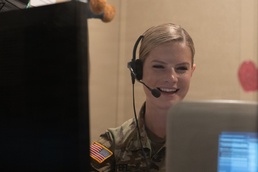
FORT BLISS, Texas — Army Reserve Soldiers of the 7248th Medical Support Unit and the 7413th Troop Medical Clinic, both of which are based out of El Paso, Texas, have been providing medical and dental staffing and support to the Vogel Hall Soldier Readiness and Processing Center here, as well as to the TMC at McGregor Base Camp, New Mexico, during their respective mobilizations here. The mobilizations are part of an Army Reserve rotational unit operation for the Fort Bliss Mobilization Force Generation Installation, or MFGI, in support of large-scale combat operations and large-scale mobilization operations.
The units serve as a hub for the mobilization and demobilization process, processing approximately over a hundred service members and civilians every day. Their job is to validate medical readiness for units going through pre- and post-deployment requirements.
Army Reserve Lt. Col. Abraham Neth, the commander of the 7248th MSU, said their mission isn’t about basic Soldier training — it is about protecting the leaders’ ability to make informed decisions.
“We validate Soldier readiness,” Neth said. “That gives commanders confidence that when they deploy their formations, those Soldiers are medically and mentally capable of contributing to the mission.”
According to Neth, in modern large-scale combat operations, the difference between success and failure can come down to how fast and how accurately a unit is prepared to deploy. For the Army Reserve, that work starts long before Soldiers board a plane or step into a combat zone.
The units have turned medical readiness into a focused, deliberate effort—one that strengthens both the Army and the Army Reserve by making sure Soldiers are medically fit, fully documented and ready to fight when called, said Neth. That validation is essential to keeping the force ready at scale.
The 7248th MSU systematically reviews medical records, prescriptions, profiles and health concerns to ensure the Army has accurate information across its protected health systems. Neth says that by doing this up front, they help reduce medical and administrative problems once units are deployed. This process speeds up the deployment process. When medical issues are found early, they can often be fixed before they turn into medical evacuations, non-deployable status or mission-limiting injuries in theater — problems that directly weaken combat power and endurance.
Each clinical section in the unit shares the same “readiness-first” mindset, Neth said.
Maj. Judy Abucejo, an Army Reserve optometrist cross-leveled to the 7248th MSU, said that eye health is a good example of something people tend to overlook — until it is too late.
“If Soldiers can’t see to standard, they can’t perform their mission,” Abucejo said. “Pre- and post-deployment screenings allow us to document, correct and protect vision health before it becomes a liability.”
She said that when Soldiers don’t fully disclose medical issues — or when their records are not complete—it can slow down mobilizations and create unnecessary risks. Those risks are amplified when problems emerge in austere environments where specialty care may not be available.
That same principle extends to the McGregor Base Camp TMC that supports rotational training units at Fort Bliss.
Army Reserve Staff Sgt. Richard Hellein, a combat medic assigned to the clinic, said the infrastructure provided by the 7248th MSU is especially important for Army Reserve and Army National Guard units that arrive without their own medical equipment.
“Our role is to keep Soldiers healthy and in the fight,” Hellein said. “When units come through here, we give them the care and documentation they need so they can continue their rotation without losing readiness.”
Every validated record, corrected profile and properly documented condition helps the Army sustain combat power in long operations—a critical need in LSCO, where units must deploy, recover and then redeploy quickly, Hellein said. For commanders, the effect of this work adds up over time.
Army Reserve Maj. Alyssa Stefl, an audiologist supporting the mobilization mission, said that what happens before deployment matters just as much as what happens after.
“We establish a benchmark before deployment,” Stefl said. “When Soldiers return, we can identify changes, document injuries and connect them to resources that protect both readiness and long-term health.”
According to Stefl, this approach supports not just the Soldiers, but also their families and leaders, by catching injuries or exposures early while preserving the Army’s ability to “fight tonight.”
As the Army prepares for large-scale combat operations in contested environments, readiness processing and clinical evaluations directly support the Army’s ability to deploy medically qualified forces.
“We’re quality assurance for the force,” Neth said. “When Soldiers are validated and commanders are informed, the Army is stronger and the mission is safer.”