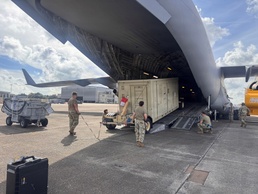
Two Airmen from the 113th Contingency Response Squadron performed key duties as part of a larger joint inspection team Jan. 04-12, 2026 at New Orleans Naval Air Station, Louisiana. The joint inspection team ensured protocols were followed and assisted in the processing of 138 personnel and 134.5 tons of equipment, disbursed across five C-17 Globemaster III cargo aircraft.
Contingency response units play a critical role in the agility of today’s military requirements. Their mission is focused in full spectrum air mobility employment, meaning they are expected to mobilize their units and establish a fully functioning air base with minimal personnel and resources. They are an elite fighting force that fully embodies the Air Force’s core concept to provide airpower “anytime, anywhere”.
The joint inspection team was composed of Airmen from the 146th Contingency Response Flight, 113th Contingency Response Squadron, 123rd Contingency Response Group and 182nd Contingency Response Group. Together they worked together to inspect and ensure all cargo was safely transported to Joint Base Pearl Harbor-Hickam, Honolulu, Hawaii. All cargo and personnel on the C-17s are slated to support the two-week Exercise Sentry Aloha that began on Jan. 14, 2026. The inspection provided the four units that made up the inspection team the opportunity to function in a joint environment and coordinated their efforts across multiple units and air force specialty codes.
During their inspection, they verified that all cargo was airworthy. They searched for any flaws such as leaks, loose equipment, sharp points that could penetrate the aircraft floor and hazardous materiel to ensure nothing would damage the C-17 during transportation. They also verified all personnel of their documentation for departure and directed them to their designation position for the flight.
Master Sgt. Darren Wiles, a special missions aviator, and Staff Sgt. Luke Rappe, a security forces specialist, both from the 113th CRS, supported the inspection wherever they were needed. Upon their arrival, they discovered that the intended team lead for the inspection was called away for another assignment and Wiles was asked to step in.
Wiles didn’t have any issues stepping into the role, crediting his past experiences taking the lead role in the field. As a part of the 113th CRS, Wiles is the contingency response team chief and holds senior airfield authority in a field expedition, which acts as an on-site commander. Since a contingency response team is constructed of enlisted members, it is a uniquely distinct environment that is void of an otherwise required commander for operations to proceed. Wiles joined his first contingency unit in 2008 when he was stationed at Ramstein Air Base, Germany. In 2015 Wiles was selected for the position as a contingency response team chief, one of six CRT chiefs currently in the Air National Guard.
“There’s a contingency response team chief in California, Minnesota, myself, Puerto Rico and two in Kentucky,” said Wiles.
This inspection provided Rappe with the opportunity to learn, grow and excel in the role of an air transportation specialist.
“Staff Sgt. Rappe was a vital member to the team,” said Wiles. “ He proved the multi-capable Airman concept is vital to mission success.”
Rappe’s expertise lies in his AFSC as a security forces specialist, but as a member of a contingency response unit he is expected to be fully competent in up to 27 AFSC’s.
Contingency response units are uniquely challenging, requiring multi-capable Airmen across career fields in order to fulfill their mission to ensure operational dominance from the ground up in austere locations across the globe.