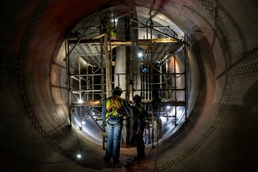
FORT PECK, Mont. – For more than 65 years, the two butterfly valves inside Powerhouse 2 at the U.S. Army Corps of Engineers, Fort Peck Dam have performed as intended, allowing operators to shut off water flow through the penstock – large underground tube-shaped structures – to conduct unit maintenance on turbines for safety purposes. But like most things, upgrades, refurbishments or replacement are eventually necessary to ensure long-lasting integrity, which is why the Omaha District is currently working to rehabilitate the valves.
“Hydropower was not part of the original design for Fort Peck Dam,” said Ron Beyer, Omaha District project manager. “It was added in 1938, five years after construction had already begun and two years before dam construction completed in 1940.”
Powerhouse 1 began generating electricity in 1943. A second powerhouse was later added to increase generating capacity to meet post-World War II energy demands. When Powerhouse 2 was completed in 1960, the two 216-inch diameter spiral case inlet butterfly valves were installed without a means for removal.
The Omaha District chose in-place refurbishment as the best way forward as there is no way to remove the 135,000-pound valves intact and removing them in pieces would require a prolonged power outage and would be both extensive and costly.
“In order for us to replace them it would probably be 10 times the cost, just with the amount of effort to come in and physically disassemble the valve discs, which would need to be cut out and hauled away, and then to haul in new disc sections and components that’d we’d have to refabricate on-site,” Beyer said. “It would be very complex. So, a much better option is to go with the on-site refurbishment.”
The butterfly valve rehabilitation project was initiated in 2018 utilizing the engineering services of the U.S. Army Corps of Engineers Hydroelectric Design Center, or HDC, said Robin Puskar, Omaha District hydropower program manager.
“Butterfly valve refurbishment is a unique scope of work within the USACE hydropower project portfolio,” Puskar said. “There are only nine plants out of the 75 or so USACE powerhouses that have these large butterfly valves.”
The HDC provided engineering expertise for the project through a three-and-a-half-year design process that included an alternatives analysis prior to starting the development of the final plans and specifications.
“Bringing this project from design into our current construction phase took a tremendous amount of teamwork,” Puskar said. “It’s been inspiring to see so many disciplines come together, share their expertise, and work through the challenges.”
Kevin Vogel, Fort Peck Project manager and construction representative, acts as the eyes and ears for the project design team, serving as a liaison between contractors and the HDC, and overseeing the work in real-time.
Vogel monitors contractors as they fabricate new bronze disc seals with stainless steel mounting, adjust hardware, ensure integrity of the welds, address coating deterioration and corrosion by sand blasting and recoating, inspect existing bearings, perform non-destructive examination of discs after blast and prior to re-coating, assess tunnel wall corrosion, and replace the valves’ shaft and thrust bearings. Contractors are also upgrading the operator on the penstock with more modernized components.
“The completed project will result in fully refurbished butterfly valves in Powerhouse 2, which includes inspection and repair of the valves and valve bodies,” Vogel said. “This rehabilitation will improve operational reliability and enhance the ability to safely and efficiently perform annual maintenance.”
According to Beyer, the updated hydraulic power units and operator for the valves will allow for fully sealed closure and shutoff of water flow in under five minutes.
“Fort Peck is unique in this design feature for the Omaha District power facilities, and that’s mainly due to the length of the power tunnel out to the reservoir,” Beyer said. At a length of 6,000 feet, original engineers chose a cost savings method to build just the one main power tunnel and then bifurcate for units four and five in Powerhouse 2.
The two generator units are supplied water through the one bifurcated power tunnel. The bifurcation allows the butterfly valve for each unit to be independently operated so each unit can be unwatered for annual maintenance. Fort Peck’s butterfly valves, which are some of the largest in the country, allow operators to shut off water flow through the penstock for maintenance on the turbines while the adjacent unit continues to operate.
Routine annual maintenance for Powerhouse 2 typically occurs from October to December each year, which aligned well with the beginning of the construction for this project in October 2025, minimizing the impact to power generation and unit maintenance in Powerhouse 1.
Major construction projects with long-term timelines are usually completed during summer months. Completing the project during the winter ensures no impact to irrigation for local agriculture.
Beyer acknowledged the harsh Montana winter has added logistical challenges for contractors bringing in work crews, equipment and new components, but overall work within the powerhouse is progressing well.
The Omaha District awarded the $9.1 million refurbishment contract at the end of 2023, and the project is estimated to be completed by spring 2026.
“This is really a generational-type project,” Beyer said. “The intent here is to make sure the refurbishment goes well, all the equipment is in good shape and functions properly post project.”
He said he expects the refurbished valves and equipment to have at least another 65-year life cycle, requiring only routine annual maintenance well into the future.