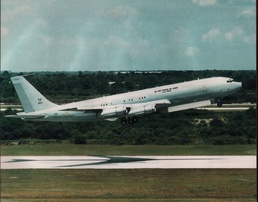
On Jan. 29, 1991, the Joint Surveillance Target Attack Radar System (JSTARS) flew surveillance of Khafji as Iraqi forces launched a ground offensive on the Saudi Arabian coastal town. Its contributions to the battle highlighted the value of the prototype system’s capabilities.
Seventeen days earlier, the hastily formed U.S. Air Force 4411th JSTARS Squadron and the U.S. Army JSTARS Operational Detachment flew two developmental JSTARS aircraft to Riyadh, Saudi Arabia, for operational use in support of Operation Desert Shield/Desert Storm. Comprised of an E-8A platform and several ground station modules (GSMs), the JSTARS provided a long range, near all-weather, night and day intelligence, surveillance, and reconnaissance (ISR) and targeting capability. It could provide wide-area surveillance with a moving target indicator and two- or three-dimensional imaging through synthetic aperture radar. Both Army and Air Force operators flew onboard the aircraft, viewing the same real-time radar data from their own operational perspective. Air Force operators looked for immediate targeting data for attack aircraft and tracked moving targets in real time. Army operators manipulated the data differently, especially in the GSMs, to look at changes through time to predict enemy ground movements.
On Jan. 14, just two days after their arrival at Riyadh, JSTARS flew its first mission, an engineering test flight that became an eight-hour intelligence-gathering mission. By the time the war ended, JSTARS crews had flown forty-nine targeting and ISR missions, mostly at night. They found the battlefield to be ideal for employment of the system, as the largely armored enemy moved in mass formations over clear and uniform terrain with little civilian presence. Enjoying air supremacy, Coalition aircraft could immediately destroy JSTARS-identified targets. Maj. Gen. Jack Leide, the U.S. Central Command J-2, argued JSTARS was the only system that could see deep enough into Iraqi-held territory to inform Coalition forces about the Iraqi Republican Guard’s response once the ground invasion began, a critical information requirement.
About ten days into the Coalition’s air campaign, which began on Jan. 17, Saddam Hussein tried to provoke a ground battle by ordering three mechanized and armored divisions to invade Saudi Arabia. The target was Khafji, a coastal town approximately 6 miles south of the Kuwaiti border, where American forces manned a series of observation posts and Coalition Arab forces defended the mostly evacuated town. As Iraqi forces in Kuwait moved toward the Saudi Arabian border between Jan. 22–28, JSTARS identified the location of Iraqi troops and when and where they were moving.
Despite this early warning, the Iraqi attack on Khafji in the evening of Jan. 29 surprised the defenders around the town, who believed the massing of Iraqi troops on the border to have been a training exercise and the potential of a large Iraqi attack unlikely. Once the battle began, the Coalition wondered if it was part of a much larger battle to come. JSTARS dispelled those beliefs when it confirmed the absence of any Iraqi reinforcements enroute. Col. Martin S. Kleiner, the U.S. Army Training and Doctrine Command Systems Manager for JSTARS, would later write, “This strongly indicated the attack was limited in nature and could be dealt with without major alterations to the ongoing campaign.” This information about where the Iraqis were NOT located allowed Coalition ground commanders in the Khafji area to better focus their assets accordingly.
While the Iraqis occupied the town, JSTARS detected efforts to resupply and reinforce the engaged troops. JSTARS operators passed this target information directly to U.S. attack aircraft, which then destroyed 70 percent of the resupply vehicles and dispersed the rest. By Jan. 31, the Iraqis in the town surrendered. Hussein’s attempt to draw Coalition forces into a large ground battle turned into a very costly failure.
The battle of Khafji was just one of JSTARS’ successes that led Brig. Gen. John Stewart, the Army Central Command G-2, to call it “the single most valuable intelligence and targeting collection system in Desert Storm.”
Article by Lori S. Stewart, USAICoE Command Historian. New issues of This Week in MI History are published each week. To report story errors, ask questions, request previous articles, or be added to our distribution list, please contact: TR-ICoE-Command-Historian@army.mil.