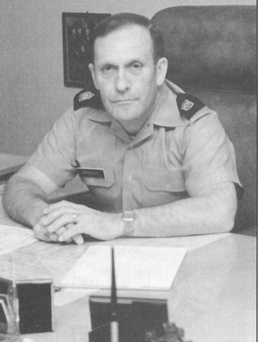
IN MEMORIAM: Cmd. Sgt. Maj. Raymond McKnight (US Army, Retired), 1998 Military Intelligence Hall of Fame Inductee (Oct. 19, 1942–Dec. 6 2025)
In 1961, 19-year-old Raymond McKnight entered the U.S. Army. Thirty-two years later, he retired after a remarkable career. In early December 2025, he died in Pensacola, Florida, at the age of 83.
Starting as a member of a low-level intercept team in Vietnam, CSM McKnight established himself as a competent Manual Morse intercept operator at both the tactical and national levels. His leadership, however, was his major contribution to the Army. After 1968, with the exception of a two-year stint as an instructor, McKnight served as a first sergeant (ten years) or as a command sergeant major (thirteen years). For his final six years, he served as the command sergeant major of the U.S. Army Intelligence and Security Command (INSCOM) for an unprecedented three commanding generals.
While at INSCOM headquarters, he helped oversee the command’s deployment of soldiers and civilians in support of Operations Just Cause, Desert Shield/Storm, and Restore Hope. At a lesser level, he provided his NCO savvy to the movement of the command’s headquarters from Arlington Hall to Fort Belvoir. Most importantly, he was a stabilizing influence as INSCOM and the Army faced force reductions and modifications while transforming into a post-Cold War force.
Throughout his tenure at INSCOM, McKnight stressed communication was “of the utmost importance” for the NCO.“ The best intentions of leaders,” McKnight noted, “will not succeed if they fail to communicate effectively.” He believed the NCO was “a stalwart of communication and a vital link between soldiers and their leadership.” McKnight took that duty earnestly. He traveled extensively and communicated to INSCOM’s soldiers with NCO calls, luncheons, group meetings, and one-on-one discussions. He also regularly wrote a column in the monthly INSCOM Journal. In these columns, he covered a wide range of topics: the particulars of promotion, gravity of counseling, relevance of retention, value of voting, and dangers of drunk driving.
These writings, moreover, provide an interesting insight into CSM McKnight’s view on NCO leadership. “These are your soldiers,” he wrote in June 1990, “you are their leader. Their reliance upon you and your attention to their distinct needs is the nature of the leadership which the NCO Corps must provide to ensure readiness in war and in peace.” For him, “attention to detail is a crowning aspect of leadership,” and should be woven into the fabric of an NCO’s daily activities. McKnight emphasized attention to detail was “the discriminating factor between success and failure.” He continued, “through attention to detail, to the smallest, seemingly unimportant aspects of any action, we [will] protect our highly capable Army…from declination to a force incapable of accomplishing its mission.”
For McKnight, loyalty was another important trait for the NCO. He believed loyalty was a leadership trait key to cohesiveness in any unit. NCOs could not demand loyalty; instead, they must develop and earn it through honesty and reliability to both the soldiers below them and the leaders above them. McKnight also stressed duty, defining it as a traditional hallmark of a professional soldier that “goes far beyond a mere listing of tasks.” To fulfill their duty, NCOs “inherently must know what we should do, often times, without direction from above.”
In an interview a few months before his retirement, McKnight observed “my name will diminish before my influence, because you train one soldier who trains another, who trains someone else.” It would probably warm the old sergeant major’s heart to know that reviewing his writings on leadership, he might be helping to train new NCOs to pay attention to detail, be loyal, discharge duty, and effectively communicate.