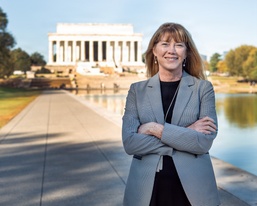
It’s safe to say Kathleen Ferguson didn’t choose the Air Force; the Air Force chose her. After earning a civil engineering degree from the University of New Hampshire, she accepted a 90-day temporary job at Plattsburgh Air Force Base in New York. “It was one of the best decisions I ever made,” she said. That short-term assignment became a 35-year civilian career devoted to strengthening Air Force infrastructure and supporting Airmen worldwide.
Ferguson began with the 380th Civil Engineer Squadron, learning quickly from every challenge. “I did not know what I was doing,” she recalled of her first project, “but I learned as much as I could in a short time.”
Over the years, Ferguson has witnessed the Air Force Civil Engineering mission expand and evolve. “Civil engineers were focused on construction, maintenance, and keeping the bases operational day to day,” she said. “But I also see civil engineering today has to be much more strategic. They need to be looking at integrating energy resilience, environmental stewardship, and advanced technologies into everything that they do every single day.”
That broadened mission isn’t limited to facilities and systems, she explained. Readiness extends beyond infrastructure to the people who make the mission possible. “Families are an essential component of readiness,” she said. “If family resilience is not there, then it’s hard for a military member to accomplish their mission.” Ferguson has seen the shift firsthand, from a time when “most spouses didn’t work and everyone lived on base” to today, when “80 percent of Airmen, Guardians, and their families live in local communities.” Today, issues like childcare and education have taken on new importance, she added, as families are now recognized as a critical element of readiness. This reflects a fundamental shift in how the Department views the military household: not as an ancillary element, but as a core contributor to mission success.
Ferguson’s sense of responsibility to the people behind the mission was tested in the aftermath of 9/11 and the anthrax attacks that followed. She was in the Pentagon that morning, “just a wedge over from where the plane hit,” and just days later had to tell her staff that one of their mailboxes had tested positive for anthrax, a deadly bacterial disease often spread through spores, which was sent through the U.S. postal system targeting media outlets and government officials.
“Having to sit down with our staff that afternoon, after having gotten through 9/11, and telling them they were possibly exposed… was certainly one of the most memorable leadership challenges I’ve had,” Ferguson relayed. The calm and compassionate disposition she showed through those crises reflect the steady, people-first leadership that defined her career.
As Principal Deputy Assistant Secretary of the Air Force for Installations, Energy, and the Environment, Ferguson strengthened vital partnerships between bases and the communities that support them. “The mission really can’t succeed without strong community partnerships,” she said. Her leadership reflected that belief, building trust across organizations and uniting people behind a shared mission.
Ferguson is quick to emphasize that success depends on the total force. “Our active duty, guardsmen, reservists, contractors and our civilian workforce are really indispensable to the continuing expertise and the needs of the military department,” she said. “Bottom line, we’re all part of one team with one mission, and our goal is to integrate into that and help the military as best as we can.”
After retiring from federal service, Ferguson now serves as a Principal at The Roosevelt Group and chairs the Air & Space Forces Association Board of Directors. “It’s truly a recognition of the role that civilians share in helping to support and defend the United States and the mission of the Department of the Air Force,” she said. “It is also a growing recognition that we are a total force–military, civilians, active duty, guard, reserves, and our contractors that work to accomplish the mission every single day.”
Even after four decades of service, Ferguson remains focused on the future. “There are so many new technologies out there–AI, data analytics, digital engineering—all of those things we could never have imagined when I first became a civil engineer,” she said. She challenges today’s engineers to ask, “How can we reimagine installations—smart, sustainable, and resilient communities—alongside the communities outside the installation?”
Her message to today’s engineers is simple: remember your impact. “A lot of times that impact is unseen, but it’s everywhere; it’s in every airplane that takes off, every Airman or Guardian going into a dormitory, and everyone that goes into a maintenance shop.”
From a 90-day temporary over hire to decades of national service, Kathleen Ferguson’s story embodies the best of the Air Force Civil Engineer enterprise—innovation rooted in tradition, collaboration grounded in community, and readiness built on resilience. When the Air Force chose Kathleen Ferguson, it chose a leader who has spent her life choosing the mission every single day.