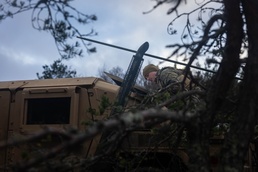
MARINE CORPS BASE CAMP LEJEUNE, N.C.—Innovation is the process of turning limitations into opportunities. When existing equipment failed to meet operational demands, U.S. Marines with 2nd Marine Logistics Group, II Marine Expeditionary Force, used ingenuity, technical skill, and mission-first thinking to develop a custom StarShield Satellite mount for Joint Light Tactical Vehicles, increasing flexibility and connectivity in austere environments.
U.S. Marine Corps Sgt. Ian Koval, a satellite communications operator with Communications Company, Headquarters and Service Battalion, 2nd MLG, and a native of Pennsylvania, was the original mind behind the creation of the mount.
“Two weeks before a deployment in 2023 is when we received our first StarShield terminals, which at the time were not able to be mounted onto our vehicles for mobile usage,” said Koval. “My peers and I created our original mount, which was just sheets of metal with magnets drilled into the top of the JLTVs, and used them for about seven months in forward environments, but we knew that it wasn’t a permanent solution.”
Mounting the StarShield terminal onto vehicles will give Marines the ability to make secure satellite connection available on the go, improving communication in austere environments and allowing uninterrupted communications without halting a convoy.
The original mount that Koval created was extremely noticeable, bulky, and needed extra wiring to harness it down to the vehicles. These issues are what prompted Koval to start brainstorming the next mount.
“I wanted to be able to add a very high-speed auto-acquire satellite terminal onto any JLTV, allowing for easy transfer and installation, while also being tactical and inconspicuous,” said Koval.
After creating the general concept for a new mount, Koval brought what he deemed the “future of mobile terminals” to Gunnery Sgt. Matthew Snow, the transmissions chief for 2nd Marine Regiment, 2nd Marine Division, for his input.
“Sgt. Koval approached me for assistance with the design, and we quickly began developing prototypes, starting with cardboard and then transitioning to thin plywood, to refine the shape and dimensions,” said Snow. “At the same time, the battalion commander of Headquarters and Service Battalion, 2nd MLG, Lt. Col. Chad Phillips, expressed interest in leveraging the II MEF Innovation Campus and fabrication shop, launching an initiative that encouraged Marines to present ideas benefiting the Fleet Marine Forces.”
Snow went on to say, “Sgt. Koval led the project and formally pitched our concept; after reviewing our prototype progress, Lt. Col. Phillips approved the effort and challenged us to deliver a fully functional prototype within two weeks.”
Following the directive from Lt. Col. Phillips, Snow and Koval headed to the II MEF Innovation Campus and the 2nd Maintenance Battalion Fabrication Shop. At the fabrication shop, Sgt. Kazden Gohl, the maintenance chief, and Cpl. Stefan Cruz, a machinist, both with 2nd Maintenance Battalion, 2nd MLG, met with Koval and Snow to find a solution, as Gohl is known to say, “made dreams come true.”
“Gunnery Sgt. Snow came in with an idea of what he wanted, and we figured out the realistic materials they would need, bolt alignment, quality of life for the handles, wave reduction, and material cost,” said Gohl, a North Carolina native. The process began with hand-designing blueprints that fit their exact needs, measurements, and materials, as well as the various tools required to create the part, explained Cruz. From there, the team designed the mount using a computer-aided design software, chose the quality of cut, set up the machine, and started cutting it.
The team chose to use aluminum due to its light weight and flexibility as well as the fact that it's cheaper than other metals, allowing for easier mass-production of the mounts for use throughout the Fleet Marine Force.
“Working as a team on this project was a blast,” said Cruz, a New Jersey native, “Everyone thinks differently and brings different ideas to the table, which is what gave us the ability to make this finished product versatile and efficient.” “We made a first version, second version, and before we knew it, we were on our final version, number five, and then we ensured that the mount was able to be universally used everywhere, by anyone, in the Fleet Marine Force, and able to mount not only the StarShield terminal, but also other terminals with a similar build,” said Gohl.
On the opposite side of the 2nd Maintenance Battalion motor pool is the II MEF Innovation Campus, a hub designed to turn operational challenges into tangible solutions. The campus provides Marines access to modern tools, collaborative workspaces, and technical mentorship, empowering them to transform ideas into deployable capabilities.
“The Innovation Campus served as the connecting link between our fabrication section and GySgt Snow and his team,” said Chief Warrant Officer Matthew Pine, the officer in charge at the II MEF Innovation Campus. “We helped produce prototypes and provided refinement based on their end user feedback prior to finalizing the design and going to production.”
After weeks of collaboration, testing, and refinement, the final mount represented more than just a piece of hardware; it embodied the Marine Corps’ ability to adapt, innovate, and overcome challenges in any environment. Koval brought the mount back to his command where it was immediately tested on a 160-mile convoy.
“It worked flawlessly,” said Koval. “No nuts or bolts loosened during the almost 160-mile journey, and the Starlink was able to maintain its connection the whole time, with amazing service results that we checked every hour.”
Koval continued, “It’s made communications so much easier and faster, it’s an auto-acquire terminal piece that’s already attached to the vehicle, and it doesn’t require anything to login or adjust, it just needs power, and it starts working immediately.”
The development of the StarShield mount highlights how innovation within the Marine Corps often begins at the lowest level, driven by Marines who refuse to accept limitations as permanent. Through teamwork, leadership support, and access to the II MEF Innovation Campus and 2nd Maintenance Battalion Fabrication Shop, Koval and his team transformed a battlefield necessity into a scalable solution that enhances command and control across the Fleet Marine Force.
As future conflicts demand greater mobility and connectivity, projects like this demonstrate that the Marine Corps’ greatest advantage remains its Marines who think creatively, act decisively, and innovate relentlessly to accomplish the mission.