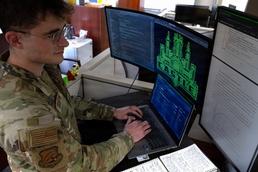
JOINT BASE SAN ANTONIO-RANDOLPH, Texas – Manpower professionals assigned to the Air Force Manpower Analysis Agency are utilizing artificial intelligence to predict how today’s decisions could affect the lethality and effectiveness of tomorrow’s Air Force.
Airmen are developing and testing the CASTLE Suite of Applications as a toolkit which could offer insight into the long-term consequences and second-order effects of accessions and manning plans.
As a modern approach, CASTLE is expected to be faster, less costly and more accurate than traditional analysis approaches.
"To fully realize the effects of a manpower decision takes 30 years,” said 1st Lt. Richard Greszler, AFMAA manpower analyst. “While we can predict short-term outcomes with high certainty, like the first year or two of training, predictability declines as we look further into the future. AI helps us close that gap by using historical patterns to forecast long-term scenarios.”
The AI model was trained on decades of existing data which includes information such as promotion, retention and accessions rates.
While speaking about the information, Maj. Gonzalo Hernando, AFMAA data science branch chief, said the data sets are massive. To produce a whole picture of what the Air Force’s future would look like, CASTLE looks at all the information at the same time which Airmen doing standard statistical analysis would have a hard time doing.
This prediction is then used to balance the demands of current operations with the requirements for tomorrow’s fight, informing decisions about funding, recruitment, incentives, promotion rates, cross-training opportunities and more.
“What this helps us do is, if senior leaders don’t like that site picture … we can go back and adjust small things and show them what the effect of that decision will be to make sure they like what the Air Force will look like,” Greszler said.
Each application in the suite supplies different sets of information.
For example, 1st Lt. Bryce Graffin, AFMAA sustainment analytics section deputy chief, said the output of one application could be a basic projection of work force numbers while another application outputs accessions plans.
The development team is keeping the effectiveness of the future Air Force in mind as they continue to test the applications and prepare them for users.
“We’re trying to look at everything, at all the different levels and lenses, to ensure that decisions made today are sustainable and beneficial to the Air Force as a whole,” Hernando said.
As warfighting continues to evolve, the implementation of modern technologies like CASTLE could be instrumental in ensuring decisions at all levels support a lethal, ready force with the right Airmen in the right places to deter aggression, and fight and win well into the future.