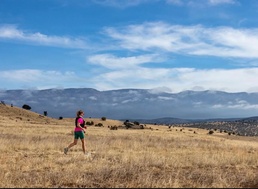
FORT BLISS, Texas — By day, U.S. Army Reserve Maj. Alyssa Stefl listens closely for what many Soldiers cannot hear. By night and on weekends, she runs farther than most would dare, pushing her body and mind to their limits in ultramarathons that mirror the endurance required in uniform.
Stefl, an audiologist and officer in charge of the audiology department during her current mobilization at Fort Bliss, Texas, plays a critical role in ensuring Soldiers are medically ready before and after deployment. As an Area of Concentration, or AOC, 72C - Audiologist, she conducts comprehensive hearing exams, writes medical profiles and counsels Soldiers on hearing loss and prevention — work that directly affects individual readiness and long-term quality of life.
“Hearing exams aren’t just a checkbox,” Stefl said. “They give us a baseline so we can identify changes after deployment and determine whether hearing loss is occupational, reportable or something that needs further care.”
Pre-mobilization screenings ensure Soldiers can hear commands, communicate effectively and safely perform their duties. Post-deployment exams allow audiologists to identify new hearing loss, educate Soldiers on risks and connect them with resources through the Department of Veterans Affairs, including monitoring services and hearing protection.
Because many Reserve and National Guard Soldiers return to noisy civilian environments or hobbies, Stefl said, education is just as important as diagnosis.
“It’s not just gunfire that causes hearing loss,” she said. “Recreational noise can be just as damaging if you don’t know how to protect yourself.”
Outside the Army, Stefl works as a private-practice ear, nose and throat audiologist, specializing in adult and geriatric care, hearing aids, tinnitus counseling and hearing protection. But her commitment to readiness extends well beyond the clinic.
Since 2023, Stefl has completed three ultramarathons, logging a personal best record of 85 miles in timed loop races that require competitors to run as many four-mile loops as possible within a 34-hour window. She has also completed four Norwegian Foot Marches while stationed at Fort Bliss — an 18.6-mile ruck march with a 24-pound pack in full uniform, often conducted late at night.
“It’s a mental toughness challenge,” she said. “You finish and then go to work the next day.”
For Stefl, the physical endurance mirrors what she finds most fulfilling about her mobilization: autonomy, connection and impact.
“As the subject matter expert, I have the time to really see the whole Soldier,” she said. “I can educate them, counsel them and help them protect their hearing for the rest of their lives.”
She also sees opportunities for growth across the force, particularly within the Army Reserve and Army National Guard.
“I’m starting to see where audiologists can play a more vital role in unit readiness,” Stefl said. “There are gaps, and there’s more we can do.”
Whether running mile after mile or counseling Soldiers one patient at a time, Stefl embodies a simple philosophy — readiness starts with listening, and resilience is built step by step.